The Embodied AI Era Officially Begins
On May 9, 2026, Suzhou LeXiang Intelligent Technology Co., Ltd. officially announced that its embodied intelligence brand Zeroth’s M1 humanoid robot has successfully integrated with Tencent’s OpenClaw ecosystem, becoming the world’s first mass-producible humanoid robot to connect to this platform.
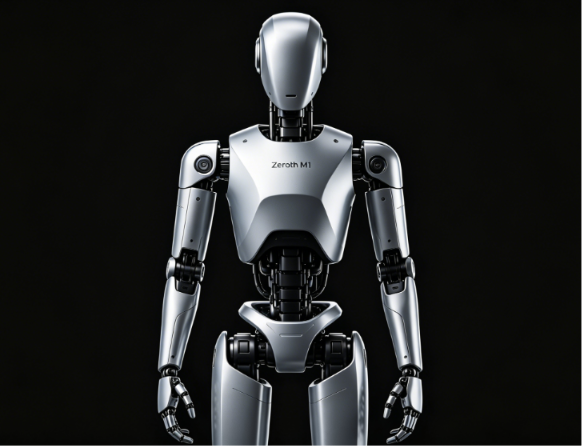
This milestone partnership marks AI Agent’s expansion from cloud and desktop applications to home physical terminals for the first time, completing the critical transition from “screen intelligence” to “embodied intelligence.”
At the launch event, LeXiang Technology and Tencent Cloud jointly demonstrated the results of this collaboration. Users can now remotely send commands to the “OpenClaw Agent” through the QQ interface, with the AI agent controlling the M1 robot to perform actions such as walking, turning, and following its owner. This natural language-driven robot control approach redefines human-robot interaction in home scenarios.
Technical Breakthrough: A Complete Loop from Cloud to Physical Terminals
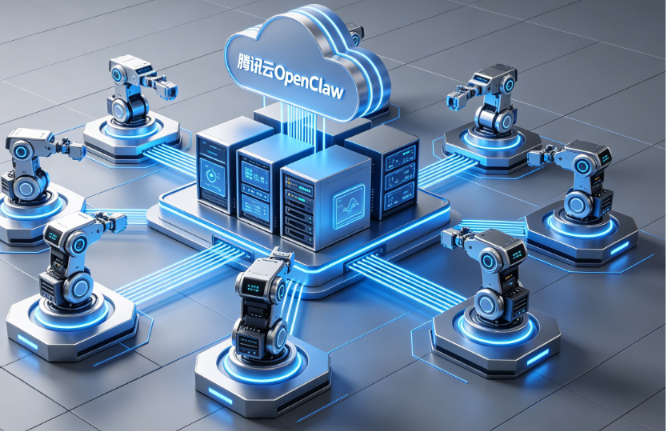
The core value of the M1 robot’s integration with the OpenClaw ecosystem lies in achieving a complete AI Agent loop. Traditionally, AI Agents primarily run in cloud or desktop environments, with users interacting with AI through screens. Through collaboration with Tencent OpenClaw, the M1 robot gains a direct connection between cloud-based AI brain and physical body.
Specifically, Tencent Cloud’s QClaw platform provides the M1 robot with powerful cloud inference capabilities. When users send commands via QQ, the cloud-based AI Agent parses user intent and directly controls the robot’s motion system to execute corresponding actions. This integrated “perception-decision-execution” capability is precisely the core characteristic of embodied intelligence.
At the launch event, LeXiang Technology’s CEO stated: “We believe AI of the future should not be trapped in screens. The M1 robot gives AI its first real physical body, enabling it to interact in authentic three-dimensional space.” This philosophy clearly illustrates the essence of embodied intelligence—moving AI beyond the digital world into entities capable of perceiving environments and executing tasks.
Commercial Landing: 10,000-Unit Target and Ecosystem Expansion
Significantly, LeXiang Technology has reached an intention with Tencent for 10,000 hardware terminal integrations, demonstrating strong confidence in this collaborative direction. The M1 robot has successfully connected to OpenClaw and entered internal testing, with plans for official launch in late May and pre-sales starting in the first half of the year.
This commercial rollout timeline reflects LeXiang Technology’s pragmatic approach to embodied intelligence deployment. Unlike many companies still in the concept stage, LeXiang Technology possesses mass production capabilities, making it an ideal hardware carrier for Tencent’s OpenClaw ecosystem. Through the 10,000-unit target, both parties aim to accumulate real-world scenario data through scaled applications, further optimizing user experience.
For Tencent, choosing the M1 robot as OpenClaw ecosystem’s first physical terminal reflects its emphasis on home scenarios. As Tencent’s AI Agent platform expands from cloud and desktop into the physical world, humanoid robots serve as the ideal carrier for completing this expansion.
Industry Significance: Filling the AI-Robot Integration Gap
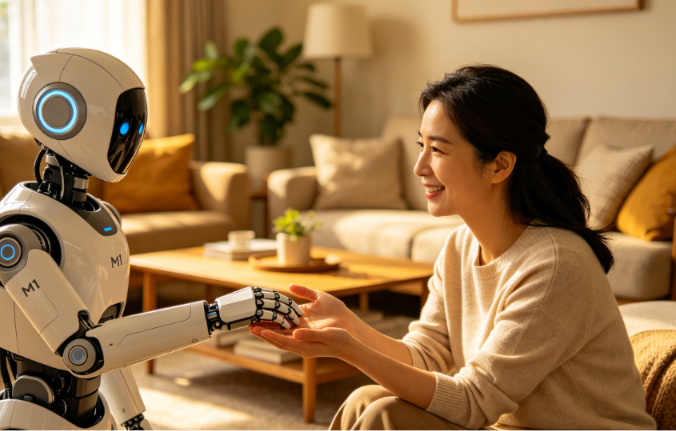
From an industry perspective, LeXiang Technology’s M1 robot integration with OpenClaw fills the “AI Agent + Household Robot” integration gap. In prior development, AI Agent and household robot sectors evolved separately, lacking effective intersection.
On one hand, AI Agents primarily operated in virtual environments—capable of processing information and invoking tools, but lacking physical execution capabilities. On the other hand, traditional household robots, while possessing locomotion abilities, had limited intelligence, struggling to understand complex commands or enabling natural interaction. The emergence of the M1 robot precisely bridges this gap—it possesses locomotion capabilities while gaining powerful AI reasoning through OpenClaw.
This integration represents a significant direction in AI development. Industry observers widely agree that with large model technology maturation, embodied intelligence will become the next major battlefield for AI commercialization. As a typical carrier of embodied intelligence, humanoid robots are transitioning from laboratories to households.
Market Prospects: Scaling Path for Household Robots
LeXiang Technology’s 10,000-unit target for the M1 robot, while seemingly conservative, reflects current challenges in embodied intelligence commercialization. Compared to mature consumer electronics like smartphones and smart speakers, household robots face higher technical barriers and user expectations.
First is the price factor. Currently, mass-producible humanoid robots are generally priced in the tens of thousands of yuan range, exceeding most consumers’ budgets. LeXiang Technology needs to control costs while ensuring product performance to attract a broader user base.
Second is scenario adaptation. Home environments are complex and variable; robots need to handle various unexpected situations. Making robots genuine helpful assistants in family life rather than expensive toys is a question all players must answer.
Finally, privacy and security. Introducing robots into homes means extensive data collection and processing; users’ privacy protection concerns cannot be ignored. LeXiang Technology needs to establish trust at the technical architecture level, reassuring users about safety.
Despite challenges, the market prospects for embodied intelligence remain widely optimistic. Analysts predict that by 2030, the global household robot market could exceed 100 billion dollars. As a pioneer in this track, LeXiang Technology’s collaboration with Tencent will accumulate valuable experience for industry development.
Final Thoughts
From screens to bodies, AI is gaining genuine “freedom of action.” LeXiang Technology’s M1 robot integration with Tencent OpenClaw marks the formal opening of the embodied intelligence era. When AI is no longer just text and sound, but can walk, turn, and interact with family members, the integration of intelligent technology and daily life enters an entirely new phase.
What follows is whether the M1 robot’s official launch proceeds as scheduled and whether the 10,000-unit target is successfully achieved. These questions will be answered in the second half of the year. Regardless, May 9, 2026, has been inscribed in AI development history—the critical step from concept to reality for embodied intelligence, hereby established.