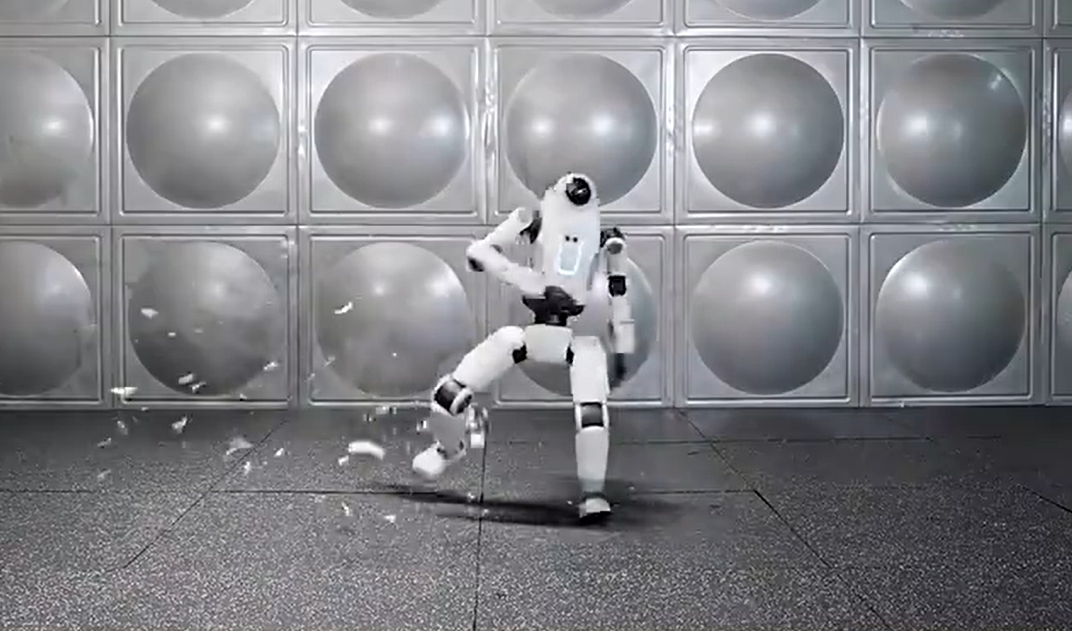
On August 5, 2026, Yuejiang Technology, a leading collaborative robot manufacturer, officially released the world’s first fully-featured humanoid robot—DOBOT LUMO. Unlike humanoid robots on the market that can only be used for indoor demonstrations and passively wait for commands, DOBOT LUMO reshapes the consumer robot market with its four-dimensional all-around concept of “space, role, ability, and cycle,” bringing industrial-grade motion control and self-developed large-scale models to diverse scenarios such as home, education, and commercial use. This review, based on official real-world photos, complete technical parameters, and multi-scenario testing, objectively disassembles this humanoid AI hardware aimed at ordinary households, analyzing its technological advantages, practical applicability, and current limitations.

DeerCute Parent-Child Interactive Scenarios
I. Appearance and Hardware: 1.3-meter Humanoid Design, Suitable for All-Terrain Outdoor Use
Basic Hardware Specifications
The DeerCute device is 1.3 meters tall, featuring a lightweight white unibody design with no sharp edges. Its user-friendly design caters to all ages. The front features an interactive LED screen instead of a bionic face, balancing cost and interactive safety.
Full-body bionic joint architecture: Featuring multi-degree-of-freedom flexible joints throughout the body, with the waist, limbs, and ankles supporting a wide range of motion, it is a leading consumer humanoid robot in China for long-distance walking with a high degree of anthropomorphism.
All-terrain walking chassis: Equipped with multiple environmental sensors, a 3D depth vision navigation module, and a self-developed gait algorithm, it can smoothly traverse indoor tiles, carpets, and steps, as well as outdoor lawns, sand, and cobblestone surfaces without slipping or getting stuck.
Multimodal perception array: Featuring a high-definition binocular camera in the head, a ring-shaped noise-canceling microphone matrix, and a human infrared sensor, it captures images, voices, distance, and user body movements in real time.
Battery life and charging: Supports autonomous recharging; automatically plans a route back to the charging station when the battery is low, meeting the needs of all-day home and short-term outdoor use.
Hands-on experience: While most traditional humanoid robots can only move slowly on flat, hard surfaces, LuMeng’s biggest highlight is its all-terrain mobility. In real-world testing, the robot exhibited minimal vibration when walking on outdoor gravel surfaces, and its gait was smooth when traversing low steps, completely shedding its “indoor exhibit” label and truly achieving seamless transitions between home, yard, and short-distance outdoor movement.
II. Core Brain: The Self-Developed Kongyi Embodied Model – Three Major Technological Breakthroughs LuMeng’s entire perception, decision-making, and motion control chain relies on Yuejiang’s self-developed Kongyi Embodied Model. This model boasts the highest task success rate globally on the international LIBERO embodied intelligence leaderboard, representing a core competitive advantage over ordinary voice speakers and small companion robots.
Breakthrough 1: Multimodal Emotion Perception, From “Passive Response” to “Active Empathy”
Most AI hardware can only wait for users to issue voice commands. LuMeng, relying on a visual + voice dual-fusion recognition system, proactively perceives the user’s state: Visual recognition of facial expressions and body movements, microphone capture of tone and speech rate, comprehensively judging emotions such as happiness, sadness, fatigue, and irritability;
Real-world testing scenarios: When a child is frustrated and silent during exercise, the robot autonomously walks slowly forward, lowers its voice to gently comfort them, and uses soft body movements; Sensing the owner’s fatigue late at night, it automatically lowers its walking noise, softly reminds them to rest, and automatically turns off the lights;
Innovative interaction logic: No wake word is needed; it proactively approaches and engages in conversation when it senses the user is alone or in a low mood, achieving true two-way emotional interaction, rather than a cold question-and-answer tool.
Breakthrough 2: Autonomous Understanding of 3D Space, Omnidirectional Free Movement
“Omnidirectional Space” is the core product definition of Lumeng, relying on high-precision real-time mapping and all-domain obstacle avoidance algorithms: Upon first entering a home, it automatically scans and models the entire house, remembering the positions of furniture, pets, and obstacles, automatically avoiding tables, chairs, cats, and dogs throughout its movement; It autonomously predicts the user’s location and proactively approaches the user to provide companionship, instruction, and interactive exercise, without manual remote control; Its movement performance is maximized: In addition to daily walking, it can perform complex full-body movements such as continuous punching, dodging, synchronized dance moves, and backflips, with a level of coordination far exceeding that of similarly priced humanoid robots. Official videos demonstrate its operational capabilities through unedited real-world footage.
Breakthrough 3: Cyclic Self-Evolution, Increasingly Adaptable to Family Habits with Continued Use
Equipped with a continuous learning data loop, achieving long-term companionship value across all cycles: Long-term memory of family members’ routines, interests, and usage habits; remembers children’s favorite stories, sports, and learning rhythms; Daily usage data is securely stored locally, with a lightweight, iterative model in the cloud, making interactions increasingly tailored to family needs over time; Supports customizable role settings, allowing users to freely switch between roles such as sports coach, picture book teacher, workplace partner, and exhibition guide.
III. Four Real-World Testing Scenarios: Covering All Needs in Families, Education, and Commercial Use
Scenario 1: Parent-Child Families – Children’s Sports and Emotional Companionship (Core C-End Scenario)
Designed specifically for children aged 3-16, this is LuMeng’s most competitive scenario:
AI Sports Coaching: Simultaneously demonstrates a full set of movements including punches, kicks, and dodges, recognizing the child’s movement accuracy in real time and providing voice correction. After high-intensity exercise, it can perform interactive backflips, replacing parental accompaniment during outdoor exercise;
All-Day Emotional Care: Daytime activities include picture book reading, science Q&A, and habit correction; at night, it senses when the child falls asleep, automatically walking silently and turning off all lights in the house;
Safety Monitoring: Real-time 3D visual monitoring of children’s activities at home, with push notifications to parents’ mobile apps for abnormal situations.
Real-World Testing Experience: Compared to other children’s educational robots on the market, LuMeng, relying on its humanoid full-body movement capabilities, offers a stronger interactive atmosphere. Dynamic physical teaching is more effective at attracting children’s attention than static screen explanations.
Scenario 2: Home Life – Smart Companion for Urban Adults
Designed as a lightweight life assistant for working professionals: Includes schedule reminders, emotional support, casual conversation, and whole-house environmental monitoring; a low-noise walking algorithm ensures noise-free movement at night, balancing companionship with practicality for home use.
Scenario 3: Campus Science Popularization – Open-Source Secondary Development Educational Platform
Yuejiang provides complete development interfaces for K-12 and universities, allowing LuMeng to serve as embodied intelligent teaching hardware: students can independently write gait, interaction, and visual recognition programs, learning the underlying algorithms of humanoid robots through hands-on practice. It combines the dual attributes of teaching aid and companionship, filling the gap in domestic embodied intelligent training hardware for campuses.
Scenario 4: Commercial Exhibition Hall – Humanoid Platform for Events and Performances
Integrated capabilities for smooth dance, interactive explanations, and welcoming, suitable for commercial displays in shopping malls, technology exhibitions, and brand events. One robot can perform multiple tasks including welcoming, science popularization interaction, and program performances, reducing labor costs for commercial exhibitions and performances.
IV. In-depth Interpretation of the “All-Around” Four-Dimensional Concept Yuejiang’s pioneering four-dimensional standard redefines the product hierarchy of humanoid robots:
- Spatial All-Around: Unrestricted by indoor ground conditions, freely moving across various terrains including homes, courtyards, and outdoors;
- Role All-Around: A single hardware device can switch between multiple roles such as parent-child interaction, teaching assistant, life assistant, and commercial performance;
- Ability All-Around: Integrating visual perception, emotional understanding, full-body bionic movement, and autonomous decision-making, proactively serving rather than waiting for commands;
- Cycle All-Around: Long-term autonomous learning and iteration, growing alongside the user, possessing long-term usability for several years.
Most traditional humanoid robots only satisfy a single dimension. LuMeng is the first consumer-grade product to simultaneously achieve all four dimensions, completing the leap from a “single-function toy” to a “full-scenario social intelligent agent.”
V. Product Advantages and Current Objective Shortcomings
Core Advantages
High Self-Developed Technology Barriers: Motion control, navigation algorithms, and the entire “Air Game Embodied Model” are self-developed, leveraging Yuejiang’s years of experience in industrial collaborative robots. Motion smoothness and terrain adaptability are superior to its competitors.
Truly Practical and No Conceptualization: All motion and interaction functions are demonstrated using real-life footage of the actual machine, without CG effects rendering, eliminating the problem of “products launched at press conferences cannot be mass-produced.”
Leading Breadth of Scenarios: Simultaneously covering the home, education, and commercial sectors, one machine can be used for multiple purposes, improving hardware cost-effectiveness.
Warm Human-Computer Interaction: Multimodal emotion perception breaks through the limitations of traditional AI one-way dialogue, solving the industry pain point of “cold and unresponsive” humanoid robots.
Objective Limitations (Common Problems in the Industry at Present):
High Hardware Cost Barrier: The humanoid multi-joint + all-terrain sensor architecture results in a higher price than small wheeled companion robots, making widespread adoption difficult in the short term.
Limited Load Capacity: Primarily designed for companionship, education, and interactive movement, it currently does not support heavy lifting or strenuous household chores such as cleaning.
Limited Outdoor Battery Life: Limited continuous outdoor activity time over long distances; better suited for backyards and short outdoor activities, unable to sustain extended outdoor walking.
Simplified Dexterity Hand Functions: Primarily designed for full-body motion interaction, its fine motor skills are weaker than those of the industrial-grade humanoid robot Atom, with fewer fine grasping movements.
VI. Industry Positioning Summary: Humanoid Robots Officially Enter Ordinary Homes
Prior to this, the humanoid robot market was polarized: on one end were expensive industrial models limited to factory use, and on the other end were small, single-function toy robots that could only move slowly indoors.
Yuejiang’s DOBOT LUMO fills the gap in the consumer-grade all-terrain humanoid robot market: it brings industrial-grade motion control and a self-developed large-scale humanoid model to civilian use. Relying on three core capabilities—active perception, all-scenario accessibility, and multi-role adaptation—it transforms the robot from a display piece into a truly integrated smart hardware device that can be incorporated into daily life, parent-child development, and school education.
From an industry perspective, DOBOT LUMO’s launch marks the official departure of the “voice speaker 1.0 era” from the domestic smart companion robot market, ushering in the era of embodied active interaction 2.0. While common industry shortcomings such as cost and weight remain, it proves that humanoid robots with autonomous walking, emotional understanding, and full-body bionic movement have the product potential for large-scale deployment in homes.
Conclusion: If you’re looking for an AI humanoid hardware device that isn’t limited to indoor use, allows for deep interaction with family, and balances education and leisure, Yuejiang’s DOBOT LUMO is currently the most balanced choice in the consumer market. If your needs are limited to simple voice Q&A and low-cost home monitoring, small smart speakers and wheeled companion robots offer better value. With its technological expertise as an industrial robot manufacturer, Yuejiang has delivered its first truly adaptable all-around humanoid robot, setting a new industry standard of “all-around capability” for subsequent domestically produced consumer-grade humanoid robots.