At this critical juncture where embodied intelligence is moving towards the real physical world, data quality has become a core bottleneck restricting model generalization. Gen DAS Dex (hereinafter referred to as Dex), officially released by Jianzhi, takes “head-hand full-modality” as its entry point, attempting to solve the long-standing industry challenge of agile behavior acquisition.
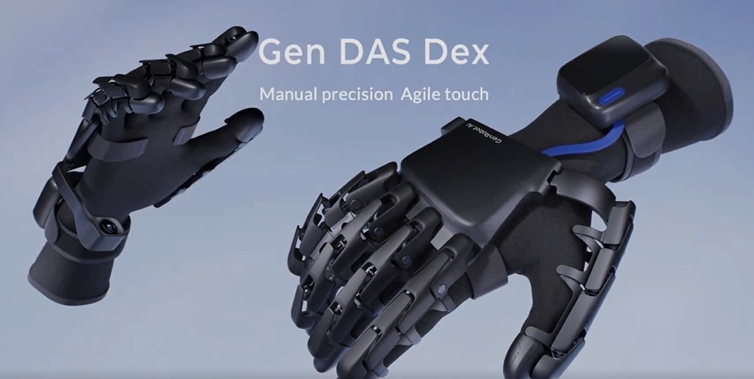
one of the key AI hardware focuses of aicrunchx , can Dex transform the fine manipulation of human hands into structured data that machines can understand? This article will provide an in-depth analysis from the perspectives of technical parameters and application scenarios.
🔍Core Functionality Analysis: Breaking Down Data Silos in “Head-Hand Collaboration”
In the past, traditional embodied training has long faced a gap of “seeing but not being able to grasp” , but now Dex’s breakthrough lies in achieving full modal closed loop with a single device .
On the hardware level, the self-developed micro magnetic encoder pushes the joint angle detection accuracy to 0.02°. Combined with IMU and infrared vision fusion positioning, the fingertip spatial error is reduced to the millimeter level, and the 23 degrees of freedom fully approach the physiological limits of the human hand.
Multimodal fusion is another highlight: the fingertip is equipped with a 0.05N high-sensitivity tactile sensor and a 1mm spatial resolution module, combined with a 150° ultra-wide-angle camera on the back, to achieve physical interaction restoration of “visual tracking of trajectory and tactile understanding of force”.
To address the industry’s pain point of multi-device synchronization, Dex also uses the SUB-G wireless protocol to connect with the underlying clock of the Ego headset, achieving sub-millisecond alignment at the 1ms level, completely eliminating timing misalignment between vision, motion, and touch.
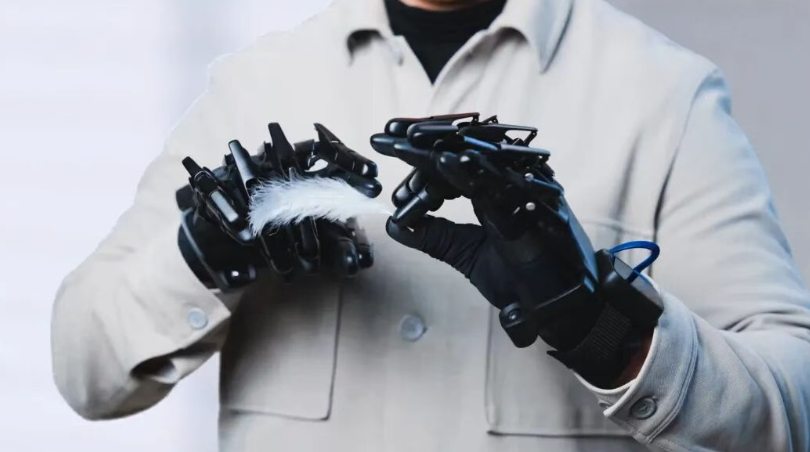
In terms of weight, the lightweight 210g exoskeleton and adaptive structure make the data collection process seamless, ensuring that the data comes from natural life rather than laboratory performances.
🌍Consumption and Industrial Application: What real-world problems can Dex solve?
Currently, the value of Dex is rapidly penetrating into the consumer and vertical sectors.
In the field of home service robots, Dex can generate a large number of real housework, cooking and tidying samples at low cost, directly solving the pain points of current home service robots such as “high failure rate of fine grasping and improper force control”.
In XR and spatial computing scenarios, high-precision hand tracking and haptic feedback data will significantly enhance the immersiveness of virtual interaction and lower the development threshold for 3D gesture training; for the medical rehabilitation market, Dex can quantify patients’ hand motor function and provide a trackable, personalized digital therapy platform for people with stroke or peripheral nerve injury.
In vocational education and skills training, experienced workers’ “muscle memory” and operational mechanics can be fully digitized and transformed into standard digital assets that can be reused remotely.
As the threshold for data collection decreases, Dex is driving a paradigm shift in embodied AI from “passively watching videos” to “active physical interaction”.
👥Background of the R&D Team and Future Evolution Path
Gen DAS’s core team has deep expertise in embodied intelligence’s underlying data infrastructure, spanning robot kinematics, micro-sensor hardware, and multimodal algorithms. The launch of Dex marks a strategic upgrade for the team, moving from a single algorithm provider to a “hardware-software integrated data engine.”
Looking to the future, Dex anticipates building a cross-brand robot training ecosystem through open SDKs and standardized data protocols; meanwhile, the mass production iteration of flexible sensors and micro magnetic encoders will drive down equipment costs, gradually opening up to independent developers and the geek market.
If data cooperation can be established with mainstream embodied basic model manufacturers, Dex has the potential to become an industry-level data acquisition standard.
📝Overview : The Inevitable Path from Data Infrastructure to Physical Intelligence
The Gen DAS Dex is not only a high-precision dexterity hand data glove, but also an indispensable “tactile and motion base” for embodied world models.
As AI begins to understand the world based on real-world human physical interactions, the large-scale deployment of dexterous machine operations has the necessary data foundation. Despite challenges in adapting to large models and commercial validation, Dex’s breakthroughs in accuracy, synchronization rate, and lightweight design have set a new benchmark for embodied data collection.
For professionals who are interested in the evolution of AI hardware and robotics, Gen DAS Dex is undoubtedly one of the most promising underlying infrastructures of the year.