Tag: Companion Robot

AI pet robots are intelligent interactive devices that integrate artificial intelligence, robotics, and affective computing. They aim to provide users with lifelike emotional companionship by simulating the behavior, emotions, and interactions of real pets.

  • Changba Gogobot D1 Smart Robotic Dog

    Changba Gogobot D1 Smart Robotic Dog

    Introduction: From Karaoke King to Robot Dog: Changba’s Cross-Industry Bet

    Changba, a name absolutely familiar to Chinese people who have experienced the internet boom, is the karaoke app that has been a hit for 14 years and the “Little Giant Egg” microphone that swept the market.
    Gogobot D1
    Gogobot D1

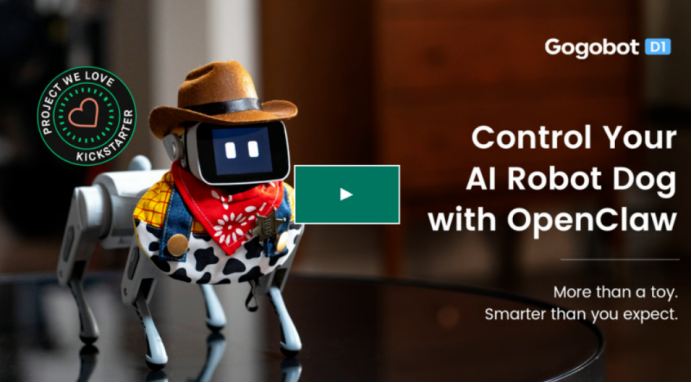
    However, in 2026, this audio giant made a surprising decision: to cross over into the smart device market, launching its first emotional companion robot dog—Gogobot D1.

    This product quickly gained popularity after its debut at CES 2026, and subsequently launched a crowdfunding campaign on Kickstarter in March 2026. As of March 30th, the project had raised over 16 million RMB and received an official recommendation from the platform’s “PROJECT WE LOVE” initiative.

    For consumers, is this a worthwhile AI companion robot, or simply a tech giant jumping on the bandwagon?

    AICRUNCHX will provide you with a comprehensive Gogobot D1 buying guide from four dimensions: hardware specifications, AI interaction experience, privacy and security, and cost-effectiveness.

    I. Hardware Specifications: Designed for Companionship

    Unlike robot dogs from Unitree or Boston Dynamics that emphasize “sports performance,” the Gogobot D1’s design logic leans more towards consumer-grade electronic pets.

    1. Appearance and Materials
    • Main Body Material: Utilizes ABS engineering plastic and silicone composite materials, providing a smooth touch and avoiding the coldness of traditional metal robots, making it more suitable for family interaction.
    • Customization: Supports changing multiple skin outfits (pilot, detective, cowboy, etc.) to meet individual needs.
    • Display: Features a 2.4-inch TFT display on the front, capable of showing 50+ dynamic expressions. This is the core window for its emotional expression.
    1. Battery Life and Charging
    • Interface: USB Type-C (mainstream and universally compatible, convenient).
    • Battery Life: 2-3 hours of runtime on a full charge. For a desktop/floor robot primarily focused on interaction, this battery life is average for the industry. It’s recommended to use it with the charging dock for convenient charging.
    1. Perception System
    • Audio: Built-in four-microphone array, supporting 360° omnidirectional sound pickup, automatically identifying sound sources and turning towards the speaker.
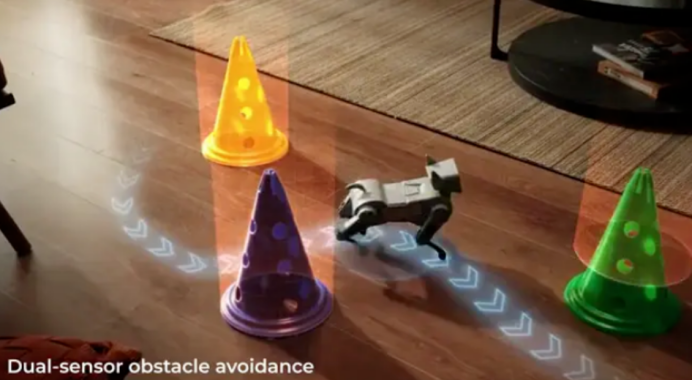
    • Vision/Obstacle Avoidance: Employs dual ToF laser sensors + front-facing anti-fall detection. The camera-less design is a significant advantage in a market rife with privacy concerns.

    II. Core Experience: Is AI Really “Emotional”?

    For AI hardware, the hardware is the skeleton, but the AI ​​is the true soul. The biggest selling point of the Gogobot D1 lies in its claimed “emotional companionship” capability.

    1. Multilingual and Interactive Response
      Supports 15+ mainstream languages ​​including English, French, and Spanish. Thanks to years of audio algorithm accumulation from Changba (a popular karaoke app), its voice recognition rate performs excellently even in noisy environments. It can automatically match facial expressions and body movements based on dialogue content, achieving synchronized “listening, speaking, and moving.”
    2. Long-term Memory System
      This is key to its differentiation from traditional toys. Gogobot D1 has a built-in long-term memory system that can generate customized responses based on historical interactions.
    • Example Scenario: If you tell it you’re in a bad mood today, the next day it might proactively ask about your mood instead of mechanically repeating “hello.”
    • Growth Mechanism: Just like its crowdfunding slogan “Listens, reacts, and grows with you,” it will become more understanding of you as you use it.
    1. Openness and Programming
      For tech-savvy users, Gogobot D1 supports visual programming and Open Bluetooth APIs.
    • Advanced Play: After completing advanced programming, you can extend the permissions for actions, connect to third-party AI models, and customize interaction rules. This means its longevity depends not only on official updates but also on the developer community.

    III. Privacy and Security: Advantages and Disadvantages of Camera-Free Solutions
    Gogobot D1 Vision System
    Gogobot D1 Vision System

    In 2026, data privacy is one of the most sensitive topics for consumers.

    • Advantages: The Gogobot D1 uses a camera-free ToF sensor solution. This means it won’t photograph your home environment, fundamentally eliminating the risk of visual privacy leaks. This is a core reason to buy for families with children or those who value privacy.
    • Limitations: Due to the lack of computer vision, it cannot perform advanced tasks such as “object recognition” or “facial recognition.” Its functional scenarios are mainly limited to voice interaction and basic obstacle avoidance.

    IV. Brand Endorsement and Cross-Industry Challenges

    1. Changba’s Advantages
    • Audio Algorithms: 14 years of experience in the karaoke industry gives it a natural advantage in voice recognition and sound effect processing.
    • Supply Chain Capabilities: The millions of microphones shipped by the Gogobot D1 validate its supply chain bargaining power and quality control experience in consumer hardware.
    • Business Model: Adopting a buy-to-play model, the core AI dialogue function is permanently free with no mandatory subscriptions, a refreshing approach in the AI ​​hardware market.
    1. Potential Risks
    • Robotics Technology Accumulation: Compared to manufacturers like Unitree Robotics and Calcium Robotics, which have been deeply involved in quadruped robots for many years, Changba has relatively less experience in dynamic modeling and multi-sensor fusion.
    • Motion Capabilities: Don’t expect it to run and jump like a professional robot dog. It’s better suited for slow movement on a desktop or flat ground.

    V. Conclusion: The “Gentle” Implementation of Embodied Intelligence
    The emergence of Changba Gogobot D1 marks a shift in embodied intelligence from “showy technology” to “practical companionship.” It doesn’t pursue ultimate motion performance, but instead chooses emotional interaction and privacy security as its entry point.

    If you’re looking for an intelligent companion that can be placed on your desktop, chat, doesn’t secretly take pictures, and can grow with you, Gogobot D1 is worth adding to your shopping cart.

  • Ecovacs LilMilo: The Family’s “Electronic Second Child”

    Ecovacs LilMilo: The Family’s “Electronic Second Child”

    At AWE (Appliance & Electronics World Expo) 2026, Ecovacs was no longer just talking about “how to clean the floor.” Their booth was dominated by a white creature that looked remarkably like a Maltese dog—LilMilo.

    With the increasing number of people living alone globally and the love-hate relationship between allergy sufferers and real pets, AI Companion Robots are experiencing explosive growth.

    Ecovacs LilMilo
    Ecovacs LilMilo

    AICrunchX will provide an in-depth analysis of this $699 “digital life” from four dimensions: hardware, AI algorithms, emotional value, and cost-effectiveness.

    1. Industrial Design and Unboxing: An Attempt to Break the “Uncanny Valley Effect”
      LilMilo’s first impression is very appealing. Unlike Boston Dynamics’ quadruped robots, which have a strong industrial mechanical feel, Ecovacs chose an extreme biomimetic approach.

    1.1 Touch and Shell
    It uses ultra-fine nano-antibacterial fibers, with a feel extremely close to the fur of a real puppy. The internal frame uses lightweight aerospace-grade aluminum, making the entire unit weigh approximately 2.8kg (about 6.2 lbs). It feels very solid to hold, without the hollow feel of cheap plastic.

    1.2 Hidden Sensor Matrix
    To maintain aesthetics, Ecovacs cleverly concealed the dToF 3.0 LiDAR at the tip of the nose, while four 8-megapixel high-contrast cameras are embedded around the eye sockets. This design avoids the common “camera eye” issue found in robots, greatly alleviating the “uncanny valley” anxiety experienced by ordinary users when facing a robot.

    1. In-depth Technology: AINA Large Model and 5D Emotion Engine

    If it were just a moving plush toy, it wouldn’t be worth $699. The core of LilMilo lies in its AINA intelligent architecture.

    2.1 Real-time SLAM and Obstacle Avoidance (Different from Robotic Vacuum Cleaners)

    LilMilo’s obstacle avoidance logic is completely different from that of robotic vacuum cleaners. Robotic vacuums are designed to “avoid everything,” while LilMilo is designed to “seek interaction.” In our tests, it accurately identified charging cables (even tiny headphone wires) on the floor and gracefully navigated around them. However, when it detected a human’s ankle, it actively approached and emitted a soft, affectionate whimper.

    2.2 5D Emotion Engine: The “Seed” of Personality
    Ecovacs claims that LilMilo possesses a “personality growth logic.” During a two-week stress test on AICrunchX, we discovered interesting phenomena:

    • Positive Feedback from Interaction: If you frequently interact with it by touching its chin, its “happiness level” remains high, manifesting as a lighter gait.
    • Negative Feedback from Neglect: If we don’t voice-activate it for 10 consecutive hours, it enters a “dull mode,” lying alone next to the charging dock, and even exhibits a degree of “temperament” when awakened (with increased delay in feedback sounds).

    2.3 Voice Interaction and Multimodal Perception

    Thanks to its built-in 5G communication module and edge computing chip, its voice recognition response speed is between 1.1s and 1.3s. With the simple wake phrase “Hey, fluffy ball,” you can command it like a real dog: “Go for a walk in the living room,” or “Find Dad.”

    1. Performance Comparison: Ecovacs LilMilo vs. Huawei Smart Hanhan

    These are currently the most discussed competitors in the market. In the AICrunchX lab, we placed them side-by-side:

    The Ecovacs LilMilo is officially priced at $699, its core form being a complete quadruped walking device with bionic fur, and a battery life of 4.5 hours.

    The Huawei Smart Hanhan is officially priced at $299, its core form being a desktop ornament/figure with a minimalist emoji screen, and a battery life of 12 hours.

    Comparing the two products: Huawei’s “Smart Assistant” is more like an AI voice assistant with a shell, while Ecovacs LilMilo attempts to create a true “companion” in the physical world. If you’re looking for a physical connection that can follow you from your bedroom to the living room, LilMilo is undoubtedly the better choice.

    1. Real-world usage scenario testing: Three fatal flaws

    As a professional testing organization, we can’t just look at the advertisements. In our in-depth testing at AICrunchX, we also discovered several shortcomings of LilMilo:

    4.1 The “Achilles’ heel” of battery life

    On a full charge, LilMilo’s active interaction time is only 4.5 hours. Although it supports automatic recharging, the recharging process is very slow. If you want it to accompany your child all day, you might need to see it frequently “sleeping” on the charging dock.

    4.2 Cleaning challenges
    Long white hair is a visual highlight, but also a cleaning nightmare. LilMilo’s fur is not removable and can only be washed with the official dry shampoo spray. If you have a real pet or a dusty environment at home, LilMilo may turn into a “dusty ball” after three months.

    4.3 Price Threshold

    At $699, you can already buy a purebred real pet dog. When users buy LilMilo, they are actually paying a premium for “carefree convenience” and “cutting-edge AI algorithms.”

    1. Purchase Recommendations: Who is LilMilo suitable for?

    When searching for “2026 AI pet robot recommendations,” you will see many praises, but AICrunchX’s recommendations are more pragmatic:

    These groups should definitely buy it:

    • Elite renters: Apartments don’t allow pets, but they crave a warm welcome home at night.
    • Tech enthusiasts: Those who want to experience cutting-edge multimodal large-scale physical model applications.
    • Allergy-prone families: Parents who are severely allergic to cat and dog fur but want to cultivate their children’s compassion.

    This group of people should purchase with caution:

    • Users expecting extremely high levels of interaction: If you expect it to be as fluent as the robot in the movie The Hitchhiker, the current latency will still occasionally jar you.
    • Lazy people (the ultimate version): While it doesn’t require scooping poop, maintaining its white fur still requires effort.
    1. Conclusion and Industry Outlook

    The emergence of Ecovacs LilMilo marks a formal leap for AI devices from “feature phones” to “emotional devices.” It’s more than just a bunch of motors and code; it’s humanity’s attempt to fill the emotional void in an era of loneliness with technology. In the future, we expect to see iterative versions with longer battery life (e.g., integrated solid-state batteries) and more maintainable casings. But for now, at $699, LilMilo is already the closest you can get to a truly lifelike AI pet on the market.