introduction
As artificial intelligence rapidly permeates the physical world, consumer robots are undergoing a paradigm shift from “functional execution tools” to “emotionally symbiotic partners.” Traditional hardware development often pursues ultimate efficiency, precision, and obedience, while neglecting the most fundamental needs of human-machine relationships: psychological acceptance and emotional connection.
Emerging explorations, exemplified by the DIY bionic robot Éloi, are attempting to solve the challenge of truly integrating AI into home scenarios through underlying architectural innovation and interactive logic reconstruction.
aicrunchx will systematically analyze its design philosophy and market strategy from three dimensions: the R&D team’s technological background, the core selling points of the products, and the evolution of AI in the industry, and will also analyze its implications for the future of smart hardware.
I. R&D Team: Cross-disciplinary Integration and a “Life-like” Technological Philosophy
The product’s R&D system exhibits a rare combination of “engineering aesthetics × underlying algorithms.” Core members possess both top-tier experience in developing bionic robots for theme parks and cutting-edge AI architecture capabilities from Silicon Valley. This background allows them to break free from the traditional path of robot development that emphasizes movement and control while neglecting expression. The team introduced the “breathing” principle from dynamic character design into hardware development, believing that the realism of a robot does not stem from the mechanical replication of movements, but rather from non-standardized, random micro-reactions and instinctive feedback.
In terms of algorithm architecture, the team abandoned the response logic that relied solely on large language models and built a unified framework centered on visual, language, and environmental awareness (VLE), and pioneered the integration of an “instinctive response layer.” Building upon their long-term accumulation of data annotation in the field of human micro-expressions and behavioral intentions, the team deeply coupled emotion recognition, environmental understanding, and autonomous feedback mechanisms, enabling the system to possess human-like psychological states such as curiosity, boredom, and resistance. Furthermore, the hardware design employing a localized, detachable memory chip not only completely cuts off the path of cloud data uploads to ensure privacy but also allows “personality and interactive memory” to detach from a single physical carrier, achieving lossless transfer and intergenerational continuation of the digital soul.
II. Core Selling Points: Modular Co-creation and Anti-Tool-Based Interaction
Éloi’s product definition directly addresses the homogenization pain point of current companion hardware, and its core selling points can be summarized as “physical flexibility” and “interaction without tooling”.
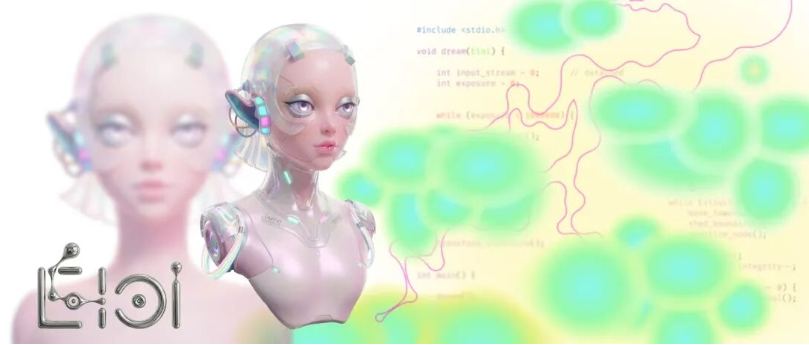
On the hardware side, the product uses a magnetic modular skull platform, allowing users to freely replace facial features, skin, and hairstyle components. Advanced users can even modify the structure within the frame. This highly open DIY feature, combined with a semi-humanoid static layout, effectively avoids the “uncanny valley effect” that can easily be caused by full-size mobile robots, significantly lowering the psychological defense threshold in the home setting.
On the interaction level, Éloi deliberately downplays its “command-response” tool attributes, instead emphasizing a “two-way” companionship logic. In standby mode, the device maintains its dynamic presence through subtle blinks, environmental scanning, and simulated chest rise and fall; its built-in self-testing system provides warnings about component wear in a human-like tone, transforming cold troubleshooting into emotional communication. More importantly, its response latency is precisely anchored within the 0.2 to 0.3 second range. This value is not simply a pursuit of technological limits, but rather a psychological test based on the rhythm of human conversation: too fast appears mechanical, too slow appears sluggish, and only this range can restore the natural rhythm of real interaction.
The product does not pursue absolute efficiency and compliance, but rather retains a moderate degree of “imperfection” to stimulate users’ emotional investment and willingness to care for it, thus truly elevating it from a “home appliance” to a “co-creating family member”.
III. Analysis of the AI Companionship Industry: From “One-Way Obedience” to “Two-Way Symbiosis”
Currently, the AI companionship market is generally trapped in the dilemma of “screen dependence” and “emotional fast food”. Most products provide instant gratification by eliminating all interaction friction, but this leads to fragile user stickiness, shallow emotional connection, and ultimately degenerates into short-lived novelty consumption.
This product’s entry strategy offers a breakthrough for the industry: the essence of companionship is not one-way taking, but rather the building of relationships that require mutual investment. Its development path clearly avoids the embodied track, which is still in its critical stage, and prioritizes focusing on high-cognition static companionship scenarios, solving “psychological acceptance” first and then iterating on “physical movement”.
This aligns with the objective laws of technological evolution and allows for a buffer period for market education. In the future, the competitive barriers for AI companion hardware will shift from simple computing power and supply chain efficiency to a comprehensive capability encompassing “content IP creation + community ecosystem operation + emotional algorithm optimization”.
Only by placing robots in real-life narratives, allowing them to have independent personalities and emotional fluctuations, and even retaining a moderate amount of “trouble” (such as needing attention or getting bored), can we break the “use and then turn off” fate of tools and establish a long-term emotional bond similar to that of pet ownership.
Conclusion
Éloi’s exploration marks a shift in companion robots from simply piling on technology to focusing on humanistic care. The R&D team, anchored by a sense of “life,” has reshaped the role of AI devices in the home through modular hardware, localized memory, and anti-tool-like interaction.
In today’s world where AI hardware is becoming increasingly widespread, these gadgets may not be able to replace human labor for the time being, but they are awakening genuine emotional connections in a warmer and more restrained way. With the iteration of multimodal algorithms and the maturity of flexible supply chains, intelligent agents with the ability to resonate with emotions are expected to become the infrastructure of future homes. How to accurately balance technological rationality and human warmth will be a question of our time that all players must continue to answer.