The smart speaker with a screen has been around for years, with most products still stuck in the traditional logic of “voice-activated music playback + video streaming.” The core change in Amazon’s new generation Echo Show 8 isn’t just a minor iteration of the screen size, but rather the upgrade from an ordinary speaker with a screen to a proactive, sensing home AI hub through its self-developed AZ3 Pro edge AI chip, Omnisense omni-channel sensing platform, and Alexa+ large-scale assistant. It no longer passively waits for user commands but can sense its environment, recognize people, and adaptively adjust its services. In this review, we’ll thoroughly dissect this product from several dimensions: appearance and hardware, audio performance, AI capabilities, smart home integration, user experience, shortcomings, and purchasing recommendations.
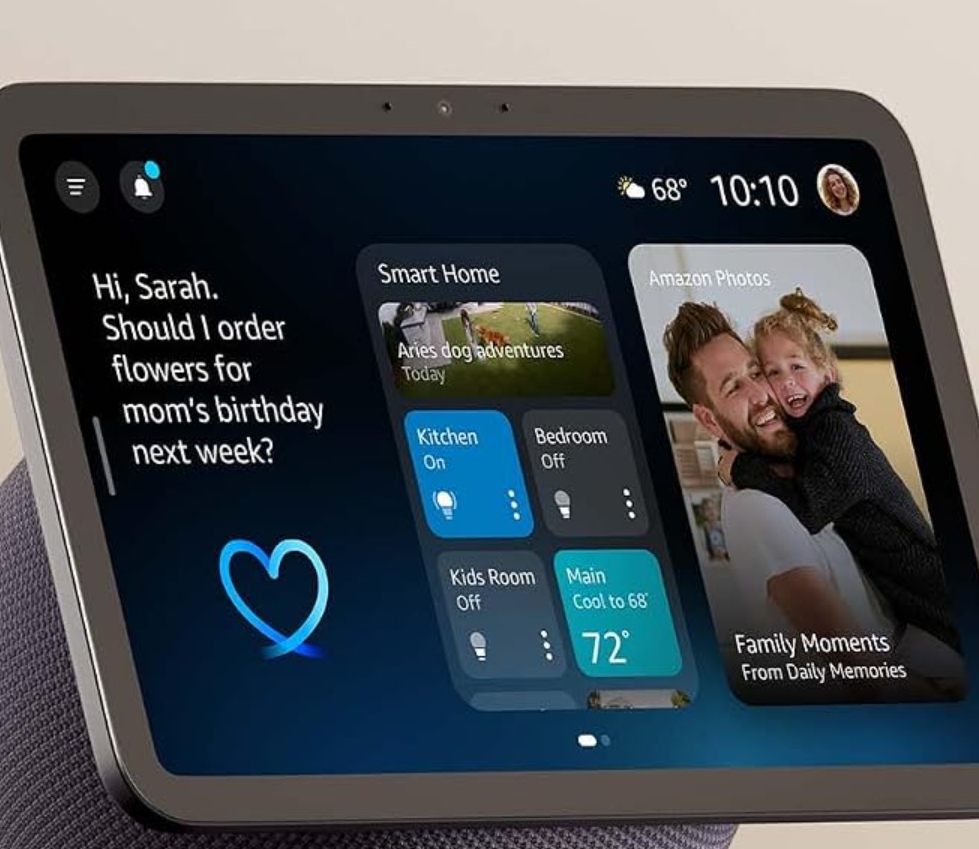
Appearance and Hardware: A Refined Desktop Home Device
The new Echo Show 8 adopts a floating screen design with a fabric-covered base. The overall lines are rounded, and it’s available in Glacier White and Graphite Black, blending seamlessly into kitchens, bedrooms, living rooms, and other home environments.
Screen: 8.7-inch HD touchscreen with a resolution of 1340×800, offering a 15% increase in viewable area compared to its predecessor. It features narrow bezels and automatic brightness adjustment based on ambient light, ensuring clear visibility of recipes and lyrics even in bright kitchen lighting. While the resolution is adequate, it’s not flagship HD, making it suitable for close-up viewing but not ideal for watching videos from a distance.
Camera: 13MP front-facing camera with automatic centering, 3.3x digital zoom, and automatic subject tracking during video calls. The physical shutter release has been removed; the microphone can only be disabled via software. Privacy-conscious users should take note.
Microphone Array: Four-microphone layout for long-distance voice pickup, combined with the AZ3 Pro chip’s noise reduction algorithm, allowing for accurate Alexa activation even in noisy kitchen environments.
Optional Accessories: €39.99 magnetic adjustable angle stand, allowing for tilt adjustment of the screen for a significantly improved desktop experience. Sold separately; not included in the package.
Connectivity: Built-in Matter, Thread, and Zigbee smart home gateways, eliminating the need for an external gateway and allowing direct connection to a wide range of smart devices; supports Wi-Fi and Bluetooth audio input/output.
Audio Experience: Spatial audio enhancement, designed for home music entertainment.
Audio is one of the core selling points of the Echo Show 8. The speaker units have been retuned, with approximately twice the low-frequency response compared to the previous generation. Equipped with a spatial audio algorithm, it creates a room-filling soundstage.
When playing pop and rock tracks, vocals are clear and transparent, with solid midrange performance. Even at full volume, there is no noticeable distortion in a medium-sized living room. The spatial audio algorithm widens the soundstage, expanding the listening experience beyond the device itself, making it suitable for everyday background music and relaxing family listening.
Real-world performance:
✅ Advantages: Clear vocals, ample loudness, excellent multi-platform music compatibility, and synchronized on-screen display of lyrics and playlist artwork, suitable for desktop and kitchen listening.
⚠️ Shortcomings: Due to the limited cavity size, the bass response depth is limited, resulting in only average performance with large dynamic range symphonies and heavy music. It cannot be compared to professional Hi-Fi speakers; it is positioned for home entertainment rather than high-end audio equipment.
On the software side, it integrates with mainstream music platforms such as Amazon Music, Spotify, and Apple Music. Combined with Alexa and a large model, features fuzzy memory song search and natural language playlist creation as highlights. You don’t need to accurately state the song title; simply describe “find a summery rock song and generate a sunset driving playlist for me,” and AI will complete song recognition and playlist creation, displaying the playlist and lyrics directly on the screen, completing a closed loop from voice interaction to visual playback.
AI Core: AZ3 Pro + Omnisense, From Passive Response to Active Intelligence
The biggest upgrade in this generation is concentrated on the AI underlying layer, which is also the key difference between this product and ordinary smart speakers on the market.
The AZ3 Pro features a self-developed edge AI chip specifically designed for edge AI scenarios. It runs large language models and visual Transformer models locally, performing a significant amount of computation on the device itself, reducing cloud reliance, resulting in faster wake-up response and reduced network latency. During video calls, AI noise reduction is simultaneously applied, filtering out ambient noise for clearer and cleaner voice communication.
The Omnisense Omni-Awareness Platform integrates multi-dimensional signals from camera visual recognition, ultrasound, Wi-Fi radar, and acoustic sensors to achieve environmental awareness.
Human Presence Detection: Detects a person entering a room and automatically triggers preset scenarios, such as turning on lights or playing music.
Visual ID Recognition of People: Identifies different family members and pushes personalized calendar, news, and music recommendations.
Environmental Awareness: Automatically triggers smart home联动 (interaction) with air conditioners, fans, etc., based on indoor temperature. While traditional smart speakers require users to speak commands to perform operations, Omnisense allows devices to sense the environment and proactively run automated processes.
Alexa + Large Model Assistant: The large model version of Alexa features more natural dialogue logic, supports multi-turn continuous conversations, and can break down complex, multi-step tasks. Prime members can use it for free, while non-members need to subscribe and pay. Currently, it primarily supports English environments and does not yet support Chinese interaction, which is the biggest obstacle for overseas hardware to be launched in China.
In everyday scenarios, it can: recommend recipes based on existing ingredients in the refrigerator, order takeout, organize family calendars for multiple people, perform fuzzy music searches, and generate travel plans.
Smart Home and Multi-Scenario Testing
Scenario 1: Kitchen Recipes are displayed on the screen, with voice control for page turning; music plays and lyrics are displayed simultaneously; when a doorbell camera is connected, the screen directly displays the visitor’s image when the doorbell is pressed; voice control of lights and sockets is also possible. The 8.7-inch screen is at a suitable viewing distance from the countertop, making it the most suitable usage scenario for this device.
Scenario 2: Bedside Table in the Bedroom View the calendar, weather, and alarm clock; the screen automatically dims at night; video call; play podcasts and white noise. However, note that the device comes with a power adapter; it is not a battery-powered version and must be plugged in to operate. It cannot be moved or placed without a power source.
Scenario 3: Home Video Calls
The 13MP camera automatically frames the image, centering the view as the person moves in front of the lens; the AZ3 Pro chip’s AI noise reduction provides excellent ambient noise suppression, ideal for cross-regional video communication within the family.
Scenario 4: Home Control Center
Built-in Matter gateway allows direct control of a vast array of smart devices, including lights, thermostats, and sensors. Visual screen control eliminates the need for a mobile app; voice and touch controls provide one-stop management of all home devices.
Product Shortcomings
Language Limitations: Alexa and core model capabilities are only supported in English, lacking Chinese localization. Domestic users cannot experience the full AI capabilities and are limited to using it as a regular speaker.
Screen Quality: 1340×800 resolution is HD, resulting in average color reproduction, unsuitable for extended periods of video watching.
No physical camera obstruction: Privacy-conscious users must disable the camera and microphone via software, lacking physical hardware protection.
Requires a power source; no built-in battery, limiting portability.
Audio is designed for home entertainment and is not suitable for users seeking ultimate Hi-Fi sound quality. Adjustable stand is an optional accessory and is not included with the product.
Summary: Who should buy it, and who shouldn’t?
✅ Suitable for:
Overseas residents, those living in an English-speaking environment, heavy users of the Alexa ecosystem, and those needing a central control unit for their entire smart home;
Suitable for kitchens and living rooms, requiring a smart speaker with a screen that can play music, make video calls, and provide visual control;
Those who value local AI on the device, environmental awareness, and automated scenarios, and seek a proactive smart home experience.
❌ Not suitable for:
General domestic users, those relying on Chinese voice assistants, and those unable to use Alexa+’s full capabilities;
Those seeking a high-definition large-screen audio-visual experience;
Those needing a portable, battery-powered speaker.
Overall Rating: 7.8/10
The Echo Show 8 (2026) represents Amazon’s understanding of next-generation home AI hardware: hardware is merely a carrier; on-device chips + multi-sensor perception + large models upgrade the smart speaker from a “voice remote control” to a home AI terminal capable of sensing its environment. While there are no disruptive breakthroughs in hardware, the entire AI software ecosystem brings about a revolution in interaction logic; limited by the language ecosystem, this powerful capability is currently more geared towards overseas markets.