
On April 24, 2026, the tech world received significant news: Apple is accelerating the development of six entirely new hardware categories, including AI-powered AirPods, smart glasses, portable accessories, smart displays, home robots, and security cameras. This announcement quickly sparked industry-wide discussion, marking Apple’s major strategic shift from a single flagship product approach to a comprehensive intelligent ecosystem.
Six New Products Outline the Future
These six upcoming products show a clear gradient distribution. AI AirPods are viewed as a natural evolution of the current audio lineup, primarily enhancing AI interaction capabilities on existing hardware—a gradual upgrade. The remaining five products, however, represent Apple’s first entry into previously uncharted territory, carrying far greater strategic significance.
Industry analysts suggest that smart glasses and smart displays represent the true strategic priorities. The core objective of these two categories is to break free from iPhone’s role as a single entry point, creating next-generation human-computer interaction interfaces and home intelligence hubs. Apple hopes to build a complete ecosystem covering personal wearable, home life, mobile office, and multiple other scenarios through these new products.
Smart Glasses: A Decade in the Making
Among the six new products, smart glasses are undoubtedly the most eye-catching. Information disclosed by overseas media reveals that Apple is developing smart glasses codenamed N50, featuring a display-free design with camera and audio components, enabling deep Siri integration.
Notably, Apple CEO Tim Cook has designated AR glasses as the company’s “highest strategic priority.” Looking back at Apple’s decade-long AR journey, the company began its布局 as early as 2016, launching the premium Vision Pro headset in 2024. However, this product failed to become a mass consumer good due to its high price and bulky form factor.
True consumer-grade AR glasses are estimated to still be several years away. Apple’s goal is to create lightweight, all-day wearable glasses that seamlessly overlay digital content onto the real world. Achieving this vision requires breakthroughs not only in optical display technology but also in balancing battery life, size, and interaction methods.
Regarding the timeline, the N50 smart glasses are expected to launch between late 2026 and early 2027, with plans to complete market availability by end of 2027. This means consumers will have to wait until at least 2027 to truly experience Apple’s AR glasses.
HomePad: A New Chess Piece for Home Scenarios
Unlike smart glasses’ long development cycle, the HomePad smart display has been scheduled for fall 2026 release. According to reports, this product extends HomePod’s audio heritage while adding touchscreen functionality, aiming to become the intelligent interaction center for home scenarios.
Industry insiders believe HomePad positions itself between smart speakers and iPad, offering both voice interaction convenience and screen-based operational advantages. With the maturing smart home ecosystem, such a highly integrated control device could become the “sixth screen” in home scenarios.
However, HomePad faces a not-so-friendly competitive environment. Amazon’s Echo Show, Google’s Nest Hub, and domestic competitors like Xiaomi’s XiaoAI Touch Screen Speaker and Baidu’s Xiaodu Smart Screen have already captured market share. Whether Apple can achieve differentiation through its traditional advantages in ecosystem integration and user experience is worth continued attention.
Home Robot: The Most Ambitious Exploration
Among the six new products, the home robot is undoubtedly the most ambitious and uncertain. This represents Apple’s first entry into the home service robot sector, positioned as a premium desktop intelligent assistant.
Sources indicate this project faces delays due to high technical complexity, with initial plans for 2027 release potentially pushed to 2028. Unlike current market offerings like robotic vacuum cleaners and delivery robots, home robots require more comprehensive capabilities in environmental perception, conversational interaction, and task execution—posing far greater technical challenges.
Analysis suggests Apple’s decision to begin home robot development at this time reflects its judgment on home scenario intelligence trends. If technical maturity reaches expectations, this product could become Apple’s most disruptive hardware innovation since the iPhone.
Ecosystem Integration Becomes Key
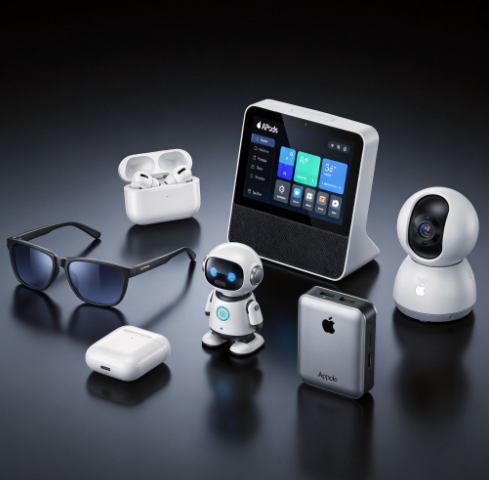
Overall, Apple’s six new hardware products show clear collaborative characteristics. Whether it’s AI AirPods’ audio interaction with smart glasses or HomePad’s home scenario connectivity with home robots, everything points in one direction: achieving seamless cross-device, cross-scenario experiences through a unified AI technology foundation.
This ecosystem-oriented approach aligns with Apple’s strategy in software services. The introduction of Apple Intelligence has provided Apple’s hardware lineup with a unified AI capability platform. As the six new products gradually launch, this platform will gain richer hardware carriers, forming a true “AI hardware ecosystem closed loop.”
Of course, the challenges Apple faces cannot be overlooked. In smart glasses, Meta’s Ray-Ban smart glasses have accumulated millions of users; in the home intelligence control sector, Amazon and Google have deep roots. Whether Apple can catch up and surpass in fierce competition ultimately depends on whether the product experience can truly resonate with consumers.