I. Company Introduction
Tenniix is not a traditional sports equipment brand, but a high-end AI sports hardware sub-brand incubated by Engins Sports Tech, a pioneer in domestic intelligent sports technology. Founded in 2018, Engins Sports Tech’s core team originated from the Human-Computer Interaction and Robotics Control Laboratories of Tsinghua University and Beijing University of Aeronautics and Astronautics, initially focusing on the research and development of industrial-grade servo systems and high-precision motion control algorithms. After 2020, the company shifted its technological accumulation to the consumer-grade intelligent sports field, successively launching products such as AI jump ropes and intelligent rowing machines. With “data-driven + precise feedback” as its core concept, it has established technological credibility in the professional fitness community.
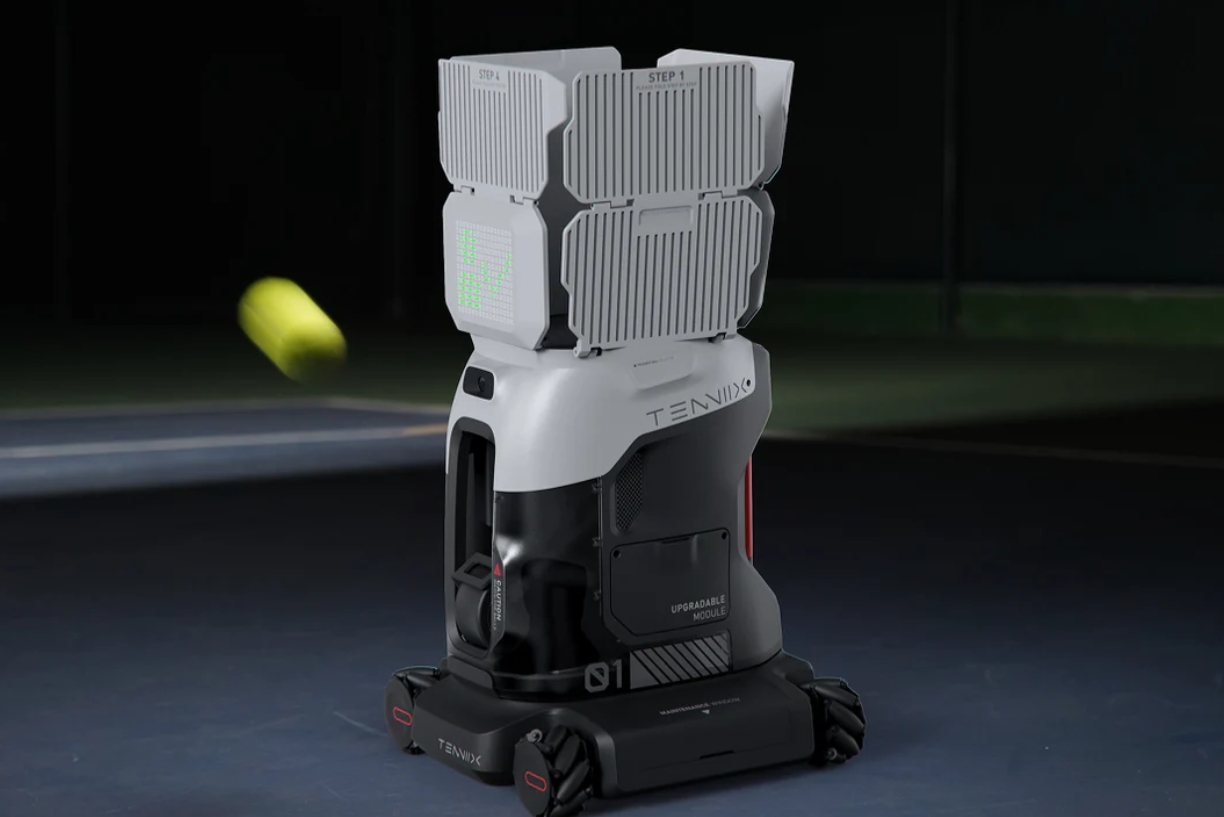
The birth of Tenniix marks Engins Sports Tech’s official entry into the intelligent competitive sports arena. Its first product—the Tenniix AI Tennis Robot—is not a simple copy of similar overseas equipment, but deeply integrates computer vision, adaptive trajectory planning, and multimodal human-machine collaboration technologies, aiming to solve three major pain points: amateur players “cannot find training partners,” professional athletes “low training repetition,” and coaches “difficulty in quantifying feedback.” Leveraging its parent company’s over ten years of experience in servo motors and real-time control systems, Tenniix has fundamentally restructured the response logic and interactive experience of its tennis robot.
II. Product Positioning & Key Highlights
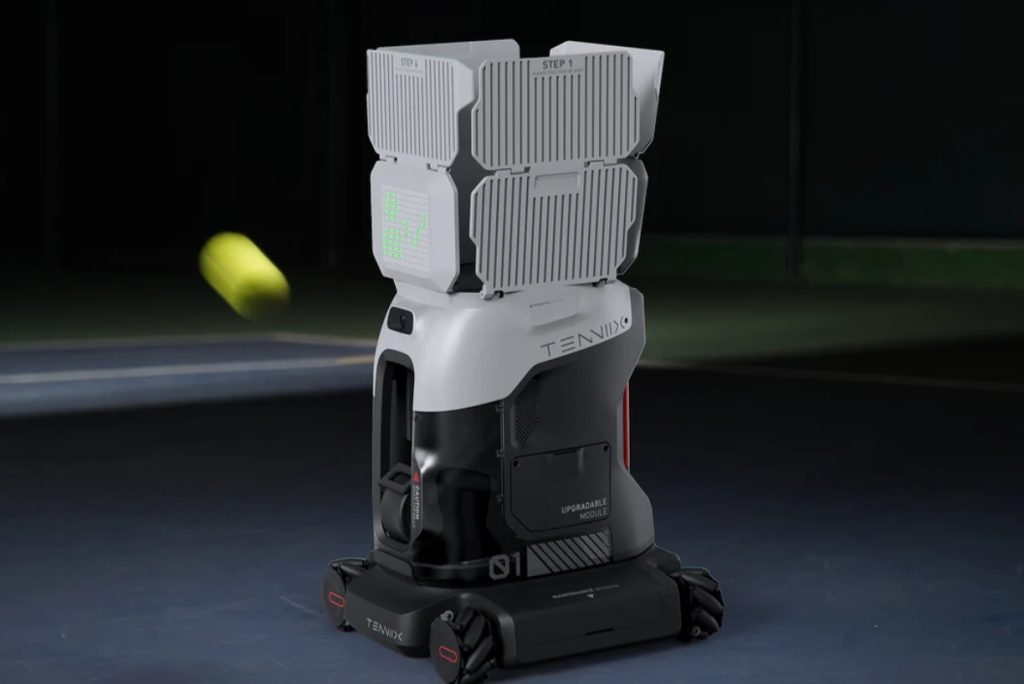
The Tenniix AI Tennis Robot is positioned as an “AI personal coaching robot for advanced tennis enthusiasts,” priced at $3,499, falling between consumer entertainment devices and professional training systems. It’s neither a children’s toy nor a million-dollar professional training platform, but rather fills a gap in the mid-to-high-end personal/home training market.
Its key highlights can be summarized in three points:
- Full-Scene AI Visual Tracking System: Equipped with binocular depth cameras and the self-developed TennisVision™ algorithm, it can identify player position, hitting posture, and landing area in real time without the need for wearable sensors, and dynamically adjust the serving strategy.
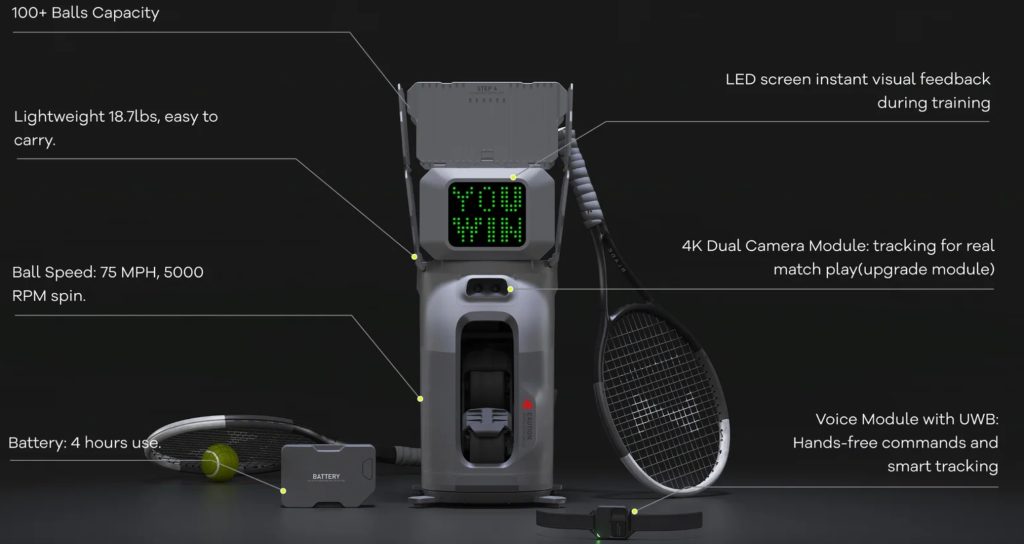
- Six-DOF Bionic Serving Mechanism: Breaking through the limitations of traditional single-axis spin serves, it simulates human arm movements through multi-joint linkage, supporting 12 spin types including topspin, backspin, flat, and sidespin, with ball speeds ranging from 30–120 km/h.
- Adaptive Training Course Engine: Generates personalized training plans based on user historical data, supporting modes such as “weakness reinforcement,” “tactical simulation,” and “physical endurance,” and can be linked with the USPTA certified course library.
III. Core Configuration Parameters
The Tenniix AI Tennis Robot features an aerospace-grade aluminum alloy frame, weighs 42 kg, and is equipped with omnidirectional silent casters for easy movement on hard courts, clay courts, and indoor surfaces. The built-in 24V/15Ah lithium battery provides approximately 2.5 hours of continuous serving on a full charge (standard training intensity) and supports fast charging (fully charged in 2 hours). The ball dispenser has a capacity of 180 standard tennis balls and uses a double-helix lifting structure to ensure continuous, uninterrupted ball feeding.
Regarding the sensing system, the top of the device integrates a pair of RGB-D cameras with a 120° field of view, a 30fps frame rate, and an effective recognition distance of 3–15 meters. It can complete a 3D model of the player’s position and hitting motion within 0.2 seconds. The bottom is equipped with a high-precision IMU (Inertial Measurement Unit) and a ground pressure sensor for real-time calibration of the device’s posture, preventing serve deviations caused by uneven playing surfaces.
The serve mechanism is the core innovation: it employs a 6-axis servo motor for coordinated control, including three main degrees of freedom: shoulder pitch, elbow flexion/extension, and wrist rotation. Combined with a high-speed launch wheel assembly, it achieves millimeter-level control over ball speed, spin, and angle. The official serve repeatability accuracy is ±2cm, far exceeding the industry average of ±8cm.
On the software side, the device runs on a custom RTOS (Real-Time Operating System) based on Linux, connecting to a dedicated app (supporting iOS/Android/Web) via Wi-Fi 6. The app provides training data dashboards, including over 20 indicators such as hit success rate, distance traveled, reaction time, and error type distribution, and supports exporting data to CSV format for coach analysis. Furthermore, the device has a reserved API interface for future integration with third-party sports physiological monitoring devices (such as heart rate monitors and electromyography sensors).
IV. Horizontal Comparison with Similar Products
Currently, the mainstream AI tennis robots in the global market mainly include the PlaySight SmartCourt series from the US (basic model around $4,200), the Babolat Play Pure Drive robot from France (discontinued), and emerging Chinese brands such as RacketBot (priced at $2,799). In comparison, Tenniix has differentiated advantages in three dimensions:
AI Interaction Depth: PlaySight relies on a fixed camera array, requires pre-installation on a court, and cannot dynamically adjust serves; Tenniix’s mobile vision system is ready to use immediately, truly achieving “ball follows the player.”
Spin Simulation Capability: Most competitors only support flat shots and basic topspin, while Tenniix’s six-degree-of-freedom mechanism can reproduce compound spins commonly seen by professional players (such as Federer-style sidespin), significantly improving training realism.
Price Threshold: Compared to PlaySight’s high installation and subscription fees (approximately $600 per year), Tenniix is a one-time purchase with no mandatory subscription, resulting in lower long-term usage costs.
Of course, Tenniix still has room for improvement in extreme environment adaptability (such as visual stability under direct sunlight) and ultra-high-speed serves (>130km/h), but for players with an NTRP of 2.5–5.0, its performance fully covers daily training needs.
V. Purchase Recommendations + Target Audience
We strongly recommend the Tenniix AI Tennis Robot to the following groups:
Advanced amateur players (NTRP 3.0 and above): Those with a basic technical framework who urgently need targeted improvement in a specific skill (e.g., backhand consistency, net volley reaction);
Families training teenagers: Can replace some private coaching sessions, reducing long-term training costs, while providing data feedback to help parents understand their child’s progress;
Small tennis clubs or university groups: Can serve as a supplementary training tool, improving training efficiency per unit of court space;
Players in recovery: Low-intensity, high-repetition lessons can be set up to help restore hitting rhythm and footwork coordination.
Situations where purchase is not recommended:
Beginners (NTRP < 2.5): Before establishing correct movement patterns, premature reliance on the machine may lead to ingrained errors.
Users with limited budgets: The price of $3,499 is still a high investment for the average consumer. Prioritize basic expenses such as rackets and lessons.
Those without a fixed training space: The equipment requires a flat space of approximately 6m x 12m. Frequent moving may affect its lifespan.
VI. Usage Precautions & Avoidance Tips
- Strict court requirements: Although it supports multiple court types, it is strongly recommended for use on flat, hard courts. Clay or grass courts can cause wheel slippage, affecting serve accuracy. For indoor courts, ensure there are no obstructions overhead to avoid misjudgments by the visual system.
- Tennis ball compatibility: Only compatible with standard pressure balls (Type 2). Pressure-reducing training balls or foam balls may cause the ball feeding mechanism to jam. It is recommended to use consistent brands such as Wilson US Open or Dunlop Fort All Court.
- Firmware updates are crucial: Tenniix employs an OTA (Over-The-Air) remote upgrade strategy. New users must complete the system initialization update before first use; otherwise, the AI recognition accuracy will decrease by approximately 30%.
- Avoid prolonged full-load operation: After serving continuously for more than 90 minutes, the machine needs to be stopped for 15 minutes to allow for cooling. Otherwise, the servo motor will trigger overheat protection, interrupting training.
- Privacy settings must be manually enabled: By default, local video data is only stored for 7 days. However, if cloud synchronization is enabled, “Automatic Upload of Training Recordings” must be manually disabled in the app to prevent the leakage of sensitive venue information.
VII. Conclusion: AI is not a gimmick, but an evolution of the training paradigm
The Tenniix AI Tennis Robot is not just another “smart toy,” but a landmark achievement of Tenniix, transforming ten years of industrial control technology into a consumer-grade sports solution. At a price of $3,499, it provides training feedback accuracy and interactive intelligence approaching that of professional teams. While there’s still room for improvement at the limits of extreme performance, its overall performance in AI visual tracking, bionic serve mechanism, and personalized course generation far surpasses competing products in the same price range.
For users who genuinely want to systematically improve their tennis skills, Tenniix is more than just a machine; it’s a tireless, data-driven, and uncompromising AI personal coach. It won’t encourage you, but it will honestly point out every weakness; it can’t replace the emotional motivation of a human coach, but it can fill the “repetitive gaps” in training with millisecond-level responses.
In today’s era where intelligent sports are moving from “connectivity” to “cognition,” Tenniix proves that true AI empowerment lies not in flashy techniques, but in making every swing a step closer to the goal.