For a long time, the vast majority of smart locks have been defined merely as “keyless locks,” with core functions limited to unlocking the door and capturing images of the area outside; AI was often little more than a marketing buzzword, capable only of basic human detection. The arrival of the Loock V7 Max seeks to redefine industry logic by transforming the entryway lock into an AI-powered sensory gateway for the home. Leveraging the synergy between the Moldia home world model and the Aurion home OS—and incorporating features such as over-the-air charging, triple-camera sensing, dual interior/exterior screens, and multimodal biometrics—it makes the leap from passive security device to proactive home steward. This lock is not merely a guardian of the entrance but the primary sensory node for the entire smart home ecosystem.
Design and Craftsmanship: Master-Class Design with a 15mm Ultra-Slim All-Metal Body
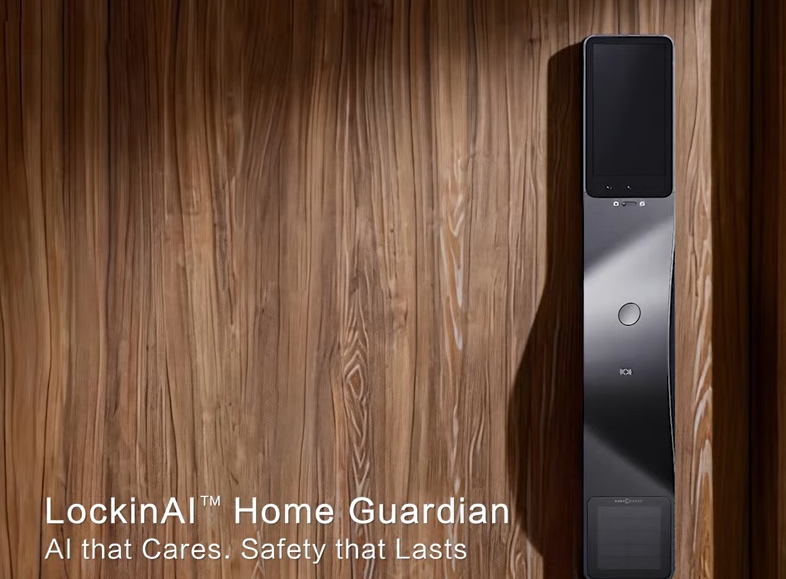
The V7 Max was designed by Hartmut Esslinger, former chief designer at Apple. The unit features a unibody die-cast aluminum alloy construction, with a front panel boasting an ultra-slim 15mm profile. It sports a signature “C-shaped” streamlined handle, with the handle area embedded with 178 “starlight” textures—a feature officially dubbed the “Starry Sky” design. This creates a premium visual aesthetic that complements various entryway styles, from modern to understated luxury.
The device employs a dual-screen setup featuring a 5-inch touchscreen on the outside and a 5-inch touchscreen on the inside. The exterior screen handles visitor interaction, displays the AI agent, and provides a preview of the area outside the door. The interior screen allows users to view live footage from the doorway, check family reminders and device status, and engage in video intercom communication; this enables the elderly and children to access information directly on the lock’s screen without needing a smartphone, thereby simplifying operation.
The lock’s structure is compatible with the vast majority of standard Chinese security doors, supporting left- or right-hand opening as well as inward or outward opening configurations. It integrates a Class C lock cylinder with an electronic lock body while retaining a mechanical key for emergency access, balancing high security with broad compatibility.
Energy Breakthrough: AuraCharge Over-the-Air Charging Solves the AI Lock Battery Life Challenge
Advanced features—such as the triple-camera system, dual screens, and large-model AI processing—place immense demands on a smart lock’s battery life. Historically, AI-rich smart locks have frequently struggled with the need for constant recharging and the risk of power failure rendering the lock inoperable. The V7 Max features Lockin AuraCharge™ infrared wireless charging technology. It comes with a dedicated charging transmitter placed in the entryway, which transmits energy via infrared light (not laser) over a distance of up to 4 meters; it holds dual safety certifications from SGS and TUV, ensuring it is harmless to the human body. With a dual-battery architecture—combining a 6735mAh main battery and a 2500mAh auxiliary battery—it achieves near-infinite battery life, eliminating the need for frequent removal to recharge. Even if the transmitter loses power, the lock’s dual batteries can continue to operate independently for an extended period, completely avoiding the predicament of being locked out due to a dead battery.
Note: The transmitter requires a nearby power outlet in the entryway, so there are specific requirements regarding the entryway layout.
Secure Unlocking: Multi-Eye 3D Recognition Suitable for All Ages
The V7 Max is equipped with the Multi-Eye® 3D Precision Recognition System, integrating three major biometric technologies—3D facial recognition, finger vein recognition, and palm vein recognition—to handle complex scenarios such as use by the elderly or children, as well as conditions like peeling or damp skin.
- Palm Vein Recognition: Identifies subcutaneous blood vessel patterns in the palm. It boasts a False Acceptance Rate (FAR) as low as 0.000000631 and can distinguish even between identical twins. It cannot be spoofed by photos or molds, offers a recognition speed of approximately 170ms, and remains reliable even with wet or peeling hands or worn fingerprints in the elderly.
- Finger Vein Recognition: Reads internal finger blood vessel data, avoiding recognition failures caused by worn fingerprints.
- 3D Structured Light Facial Recognition: Verifies three-dimensional facial data; it cannot be fooled by photos or videos, enabling a seamless, hands-free entry experience.
It also retains multiple unlocking methods—including PIN codes, NFC, Bluetooth, mechanical keys, and remote app authorization—ensuring every family member can find a method that suits them best. ## LockinCam Sentry Triple-Camera System: Comprehensive Indoor and Outdoor Awareness
At the hardware level, it employs a “Sentry” triple-camera architecture—featuring two outdoor cameras and one indoor camera. Outdoors, a wide-angle panoramic lens captures the broad view, while a low-angle lens specifically monitors ground-level items like packages and shoes. Indoors, a camera monitors the entryway; combined with millimeter-wave radar, the system ensures complete coverage of the area immediately outside the door (top to bottom) and the indoor entryway, leaving no blind spots.
A key highlight is pre-event recording: the system begins recording three seconds before an anomaly occurs, capturing the entire event sequence so no critical evidence is missed. AI automatically identifies people, packages, loitering, and unusual activity, generating text summaries of events. Users can read event descriptions directly in the app to quickly understand what happened at the door—without scrubbing through video frame-by-frame—and receive timely alerts for issues like unattended packages or loitering strangers.
A True AI Experience: Powered by the Moldia World Model, Transforming the Lock into a Home Steward
This is the primary distinction between the V7 Max and standard smart locks. It goes beyond mere video alerts; powered by the Moldia home world model and Aurion home OS, the lock evolves into an AI gateway for the home. It delivers five levels of AI capability—monitoring, companionship, interaction, task execution, and management—through a synergy of local processing and cloud-based large models. It features a dedicated AI agent named “Xiao Lu” (Little Deer), which supports customizable avatars and skins, including a co-branded “Door God” character from the Palace Museum.
- AI Monitoring: The Sentry mode accurately detects unusual loitering, unattended packages, and children wandering out, proactively pushing alerts for anomalies. Customizable indoor screen reminders help safeguard the family—such as reminding children to grab their belongings or offering health tips to the elderly as they leave.
- AI Companionship: AI scene recognition automatically captures family highlights—like hugs or homecoming moments—and edits them into short videos, preserving heartwarming memories and providing emotional value.
- AI Interaction: When a visitor rings the doorbell, the AI agent responds proactively. Elderly family members and children can call others with a single touch, enabling video intercom communication across screens without needing a smartphone. 4. AI-Powered Tasks: Video semantic search allows you to quickly locate specific surveillance clips using natural language descriptions, eliminating the need to manually scrub through timelines.
- AI-Powered Management: Proactive household management reminders and scenario automation; the lock links with whole-home devices based on the entry and exit status of family members.
It supports the Matter protocol and integrates with HomeKit and the Loock smart home ecosystem. When the lock detects a family member returning home, it automatically triggers devices such as lights, curtains, and air conditioners, creating a seamless link from the entryway to the entire home.
Hands-on Summary: Pros and Cons
✅ Product Highlights
- Over-the-air (OTA) charging with a dual-battery architecture: Solves the industry pain point of frequent charging for high-end AI smart locks, ensuring AI functions remain active long-term.
- Triple biometric authentication: Combines palm vein, finger vein, and 3D facial recognition for high security; user-friendly for the elderly, children, and those with compromised hand conditions.
- Sentinel triple-camera system with pre-recording: Provides comprehensive monitoring inside and outside the door; AI automatically generates event summaries, significantly improving review efficiency.
- Dual touchscreens (interior and exterior): Lowers the barrier to use for the elderly and children, enabling viewing and intercom functions without a smartphone.
- Powered by the Moldia home world model: Transforms the lock from a mere security tool into an AI gateway for the home, offering proactive “butler” capabilities and full smart home integration.
- Master-class design: Ultra-slim, all-metal body offering exceptional aesthetics and build quality.
⚠️ Areas for Improvement
- High-end positioning and pricing: The ¥4,799 price point represents a significant investment; requires an over-the-air charging transmitter and a nearby power outlet in the entryway, which may limit installation in older homes.
- Reliance on software updates: Many advanced AI capabilities depend on software iterations; some premium “home butler” features require future OTA updates to fully unlock their potential.
- Size and form factor: The unit features multiple modules and a relatively large size; compatibility needs to be verified beforehand for non-standard doors or ultra-narrow door frames. ## Who Should Buy It?
Recommended for: Households seeking whole-home smart integration; families with elderly members or children; those prioritizing entryway security and frequent package deliveries; and users with a sufficient budget who want a comprehensive, all-in-one AI-powered entryway device. Users within the Apple HomeKit ecosystem should give this priority consideration.
Proceed with Caution If: You have a limited budget; there is no nearby power outlet at the entryway; the door structure prevents installation; or you require only basic unlocking and peephole functions.
Final Thoughts
In the past, competition in the smart lock market largely focused on isolated specifications like recognition speed, peephole clarity, and battery life. The Loock V7 Max breaks away from this “rat race” to redefine the role of the smart lock. As the point of most frequent interaction in the home, the entryway serves as the ideal platform for the V7 Max; by integrating sensing, recognition, AI inference, interaction, and whole-home automation, it represents a new direction for smart home hardware. Hardware is no longer merely an isolated device, but a sensory gateway for embodied AI within the home.