Small Chip, Revolutionary Change

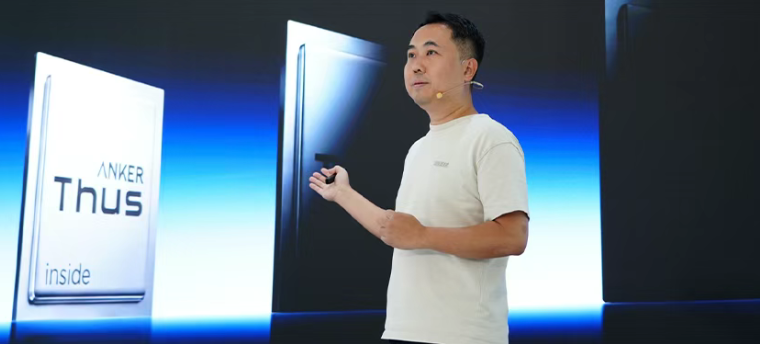
On April 22, consumer electronics giant Anker officially unveiled its self-developed Thus chip, sparking widespread industry attention. The company claims this chip is the “world’s first neural network in-memory computing AI audio processor,” which will fundamentally change our understanding of AI capabilities in small audio devices like earbuds.
During the launch event, Anker CEO Yang Meng explained the core innovation of the Thus chip: “Until now, all AI chips have been designed with separate storage and computing units. During every inference operation, devices must move parameters back and forth multiple times per second. Thus places computation directly where the model is stored, eliminating the need for data movement.”
This in-memory computing architecture sounds simple, but it represents a fundamental shift in chip design philosophy. Traditional AI chips constantly shuttle data between storage and computing units, consuming significant energy and introducing latency. In an in-memory computing architecture, computation occurs at the data storage location, completely eliminating this bottleneck.
Why Start with Earbuds
Anker’s choice of earbuds as the first application for the Thus chip was by no means coincidental. In Anker’s view, earbuds are precisely the most challenging product category for embedding AI chips.
First, the internal space in earbuds is extremely limited. Every cubic millimeter must be carefully planned, with components arranged at extremely high density. Traditional AI chips simply cannot meet these stringent space constraints.
Second, earbuds have extremely strict battery life requirements. Users often wear earbuds for extended periods, requiring chips to provide sufficient computing power while maintaining ultra-low power consumption.
Third, earbuds need to be ready at all times. Unlike smartphones, users wearing earbuds expect AI features to be available instantly without noticeable delays or interruptions.
These challenges make AI upgrades for earbuds particularly difficult, making Anker’s breakthrough even more significant. Previous solutions, limited by hardware capabilities, could only use small neural networks with hundreds of thousands of parameters. The Thus chip, leveraging its energy-efficient in-memory computing architecture, can process millions of parameters—a qualitative leap in computing capability.
A Quantum Leap in AI Noise Cancellation
For ordinary users, the most tangible value of the Thus chip lies in its improvement to call noise cancellation.
Traditional AI call noise cancellation primarily relies on small on-board neural networks. In particularly noisy environments, such solutions often struggle: environmental noise mixes into calls, or voices are over-suppressed, resulting in unnatural sound. This is a dilemma stemming from limited model capacity that cannot accurately distinguish human voices from complex environmental noise in various scenarios.
Anker states that new earbuds equipped with the Thus chip will feature larger-scale neural networks. Combined with hardware configurations of 8 MEMS microphones and 2 bone conduction sensors, the system can more precisely capture the user’s voice. Even in high-noise environments like concert venues, busy restaurants, or subway platforms, users can enjoy clear call quality.
More powerful AI capabilities also open up additional possibilities. Online translation, voice assistants, and real-time transcription will all be implemented on the earbuds themselves, with significantly improved response speed and accuracy. These features no longer need to rely on cloud processing—user voice data always stays on the device, protecting privacy while lowering usage barriers.
Speculation on First Products
Anker has not yet announced the specific models of the first earbuds equipped with the Thus chip, but the industry has made many guesses.
According to The Verge’s report, the first earbuds powered by the Thus chip are likely the Liberty 5 Pro Max and Liberty 5 Pro. These two products are expected to be priced at $229.99 and $169.99 respectively.
From the naming convention, these products should belong to soundcore’s high-end product line. Considering the Liberty series’ consistent market positioning, we can expect these new products to excel in sound quality, noise cancellation, and battery life. With the AI capabilities brought by the Thus chip, they will offer users entirely new experiences.
Anker revealed that complete product information will be officially announced at the Anker Day event on May 21. At that time, we will see the Thus chip’s performance in real products and more AI features planned by Anker.
AI Empowering the Entire Product Line
Notably, the Thus chip is only the first step in Anker’s AI strategy. The company’s goal is to bring local AI capabilities to all product lines, covering audio devices, mobile accessories, and IoT devices.
In the audio device sector, beyond earbuds, speakers, microphones, and other products will also benefit from the Thus chip’s powerful AI capabilities. Imagine smart speakers that more accurately recognize voice commands, or portable microphones that eliminate environmental noise in real-time—these will all significantly enhance user experiences.
In the mobile accessories sector, products like power banks and chargers could also incorporate AI capabilities. For example, smart power banks could optimize charging strategies based on device usage patterns, extending battery life.
In the IoT sector, the Thus chip’s low-power characteristics make it an ideal choice for various smart home devices. From smart light bulbs to security cameras, edge AI will make these devices smarter and more independent.
Industry Impact and Future Outlook
Anker’s breakthrough is not only a significant milestone for the company but will also have far-reaching effects on the entire consumer electronics industry.
First, it demonstrates the feasibility of applying in-memory computing architecture in consumer electronics. Previously, this technology mainly existed in academic research and data center scenarios. Anker’s successful productization points the way for other manufacturers.
Second, it showcases the value of vertical integration in the AI era. Anker develops its own chips while controlling terminal product design and software algorithms—this end-to-end optimization can maximize hardware potential.
Third, it may trigger a wave of AI audio chip development. Chip manufacturers and terminal companies sensing business opportunities will accelerate their layout in this field, driving rapid technology iteration.
Of course, challenges remain. Chip mass production yields, coordination with other chips, and the maturity of software development toolchains all need time to resolve. But regardless, Anker has taken the crucial first step.