In Helsinki, Finland, a technology company called Alveos Health is quietly revolutionizing respiratory health. Unlike Silicon Valley giants who are keen on piling more sensors on their wrists or embedding complex displays in glasses, Alveos firmly believes that “sound” is the most natural and hidden window to the body’s internal health.
Founded in 2019, Alveos was co-founded by a group of acoustics experts from Nokia Bell Labs and top pulmonologists. Their mission is extremely simple: to liberate professional lung auscultation capabilities from hospital clinics and empower every ordinary person with advanced acoustic artificial intelligence technology. In a world where chronic respiratory diseases are increasingly becoming a global health burden, Alveos seeks to prove that the most profound health insights are often hidden in the sounds of our every unintentional breath.
Hidden Health Sentinels in Your Collar: Redefining Respiratory Monitoring
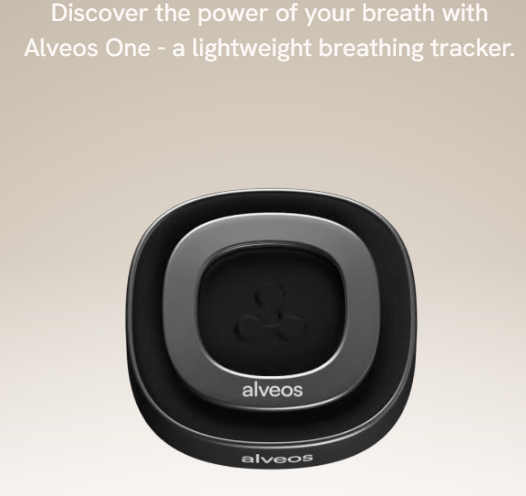
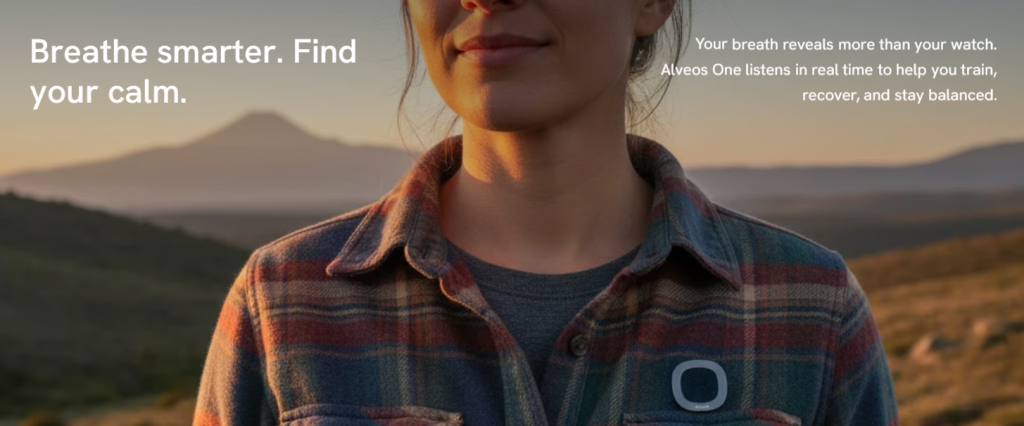
Alveos One has a clear and unique product positioning: the world’s first acoustic AI wearable device designed specifically for continuous respiratory health monitoring. It is neither a smartwatch nor a traditional medical recorder, but a miniature device resembling a delicate brooch or lapel clip. Its core concept is “unobtrusive listening and proactive alerts,” aiming to fill the gap in respiratory health monitoring in daily life.
Its core highlights are mainly reflected in three disruptive dimensions:
First, there’s medical-grade acoustic fingerprint recognition. Alveos One doesn’t rely on optical heart rate or blood oxygen estimation; instead, it directly captures the subtle sounds produced as airflow passes through the respiratory tract via a high-sensitivity microphone array. Its self-developed DeepLung AI algorithm, trained on millions of hours of clinical breath sound data, can accurately distinguish normal breath sounds from pathological features such as wheezing, crackles, and stridor, and can even identify variations in early cough patterns.
Secondly, there’s the environmental noise separation technology. This is Alveos’s competitive advantage. In noisy everyday environments (such as subways, offices, and streets), ordinary microphones cannot extract effective breathing sounds. Alveos One uses beamforming and adaptive noise reduction algorithms, acting like an “acoustic spotlight” to automatically filter background noise and lock onto only the user’s breathing sound source from their neck, ensuring data purity.
Finally, there’s predictive health insight. It doesn’t just record “what happened,” but also predicts “what will happen.” By analyzing subtle changes in respiratory rate variability (RRV) and nighttime breathing patterns, Alveos One can issue early warnings 24-48 hours before an asthma attack or acute exacerbation of COPD, giving users valuable time to intervene.
Hardcore Deconstruction: When Finnish Design Meets Cutting-Edge Acoustic Technology
Beneath its minimalist Nordic design exterior lies a remarkable engineering marvel. Every feature is designed to ensure clear hearing, accurate calculations, and comfortable wear.
Acoustic Sensing System: The core of the device features a custom-designed four-microphone phased array with a sampling rate of up to 48kHz and a frequency response range covering 20Hz to 20kHz, specifically optimized for capturing low-frequency breathing sounds. Combined with a bone conduction vibration sensor, it forms a dual verification mechanism of “air conduction + bone conduction,” greatly improving data accuracy in motion or speech scenarios.
Edge computing chip: It features a built-in independent low-power NPU (Neural Processing Unit), where all raw audio data undergoes real-time feature extraction and encryption locally, with only the anonymized analysis results uploaded to the cloud. This not only reduces latency but also fundamentally protects user privacy—your breathing sounds never leave your device.
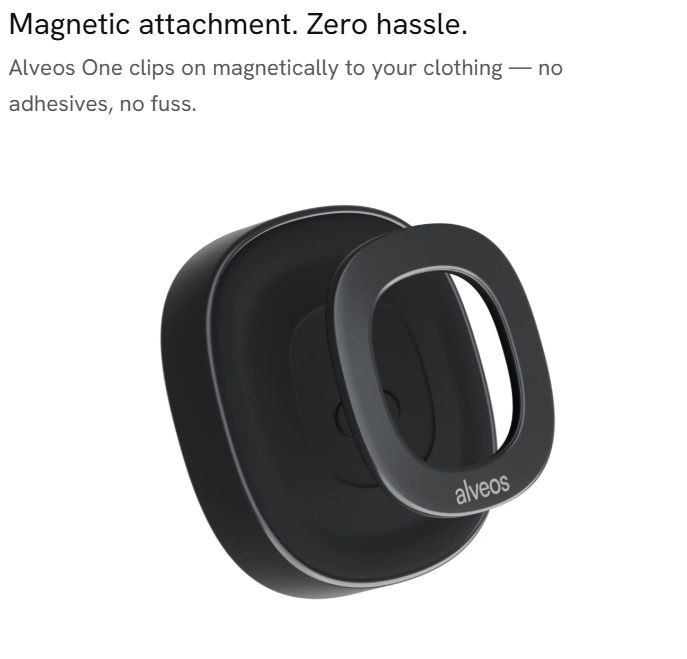
Industrial Design and Materials: Adhering to Finnish design aesthetics, the Alveos One features a recycled aluminum alloy shell and skin-friendly bio-based silicone backing, weighing only 12 grams. Its magnetic design allows it to securely attach to a collar, pajamas, or a dedicated lanyard, positioned precisely in the suprasternal notch—the golden point for collecting breath sounds. IP67 dust and water resistant, it’s impervious to sweat and rain.
Battery life: Thanks to a dedicated low-power acoustic architecture, it provides up to 36 hours of continuous monitoring on a single charge, meeting the needs of all-day wear and overnight sleep monitoring. It supports USB-C fast charging; a 15-minute charge provides a full day’s use.
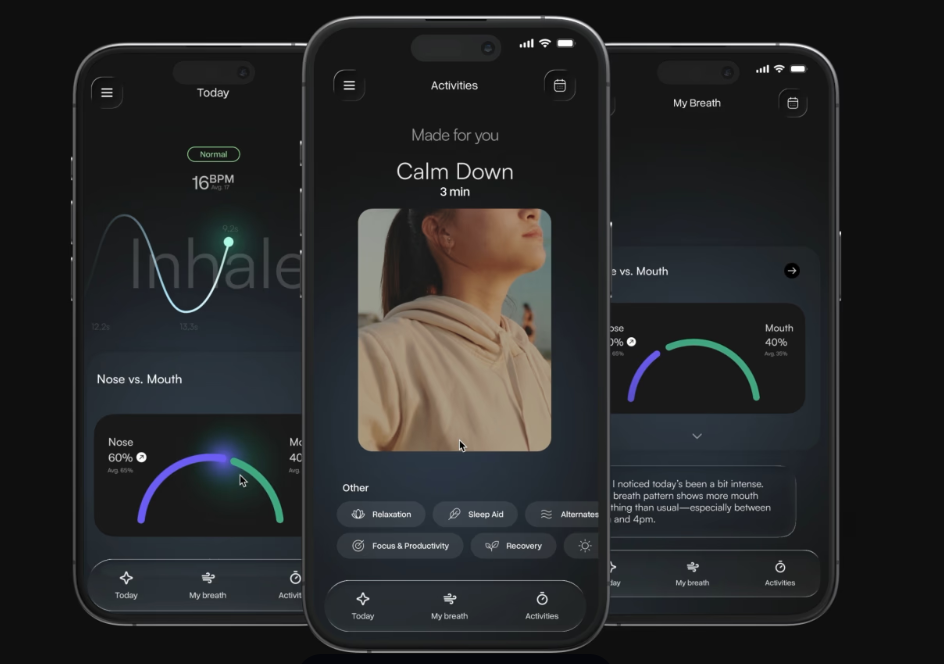
Software ecosystem: The accompanying app provides an intuitive “respiratory health score,” generates detailed daily and weekly reports, and supports integration with the electronic medical record system (EHR) to facilitate remote data access for doctors.
Investing in health: Who needs this private listener?
As a groundbreaking product, the Alveos One’s pricing strategy reflects its professional medical attributes and high-end hardware costs. Currently, the official retail price of the device is $349.
Highly recommended for the following groups:
For patients with chronic respiratory diseases: Alveos One is a lifesaver for managing asthma, COPD, and bronchiectasis. It objectively records fluctuations in symptoms, reduces indiscriminate medication use, and provides life-saving early warnings before acute attacks.
For people with allergies and seasonal sensitivities: During pollen season or on days with poor air quality, it can quantify the specific impact of the environment on the respiratory tract, helping users make informed decisions about outdoor activities.
Postoperative rehabilitation and the elderly: For patients who need to monitor their lung function recovery after lung surgery, or elderly people living alone, its real-time monitoring and emergency contact linkage function provides a great sense of security.
Elite athletes and coaches: Used to optimize breathing efficiency training, monitor lung recovery after high-intensity exercise, and prevent exercise-induced bronchoconstriction (EIB).
Purchase Caution Notice:
If you’re simply looking for a basic pedometer or sleep tracker, there are cheaper options available. The Alveos One offers a more focused and specialized value proposition; without a specific need for respiratory health management, its high hardware and subscription costs may seem overpriced. Furthermore, it requires proper placement near the trachea to achieve optimal results, demanding certain wearing habits.
Conclusion: Let every breath be treated with gentleness
Through in-depth testing and data verification, Alveos One embodies a touching sense of technological warmth. It lacks a dazzling screen and doesn’t pursue complex functions; it simply clips quietly to your collar, faithfully protecting the most instinctive rhythm of your life—your breathing. The most impressive moment in testing was when it detected a slight change in the user’s breathing sounds late at night and gently prompted the next morning: “Your airway resistance increased slightly last night. We recommend avoiding strenuous outdoor exercise today and paying attention to moisturizing.” This data-driven care is more powerful than any general health advice.
Of course, as a first-generation product aimed at the general public, its performance in extreme wind conditions still has room for improvement, and the accuracy of AI in recognizing rare breathing sounds also needs to be continuously refined with the accumulation of data. However, its merits outweigh its flaws; the emergence of Alveos One marks an important expansion of digital health from the “cardiovascular center” to the “respiratory system.”
In the post-pandemic era, respiratory health has never received such global attention. The significance of Alveos One lies in transforming what was once a doctor’s stethoscope into an accessible daily companion for everyone. The highest level of technology is not about making humans dependent on machines for survival, but about making machines an extension of humanity’s self-awareness and appreciation for life. When we can clearly hear the whispers of our own bodies, we gain control over our health. For everyone who cherishes the freedom to breathe, Alveos One is not just a $349 device, but a solemn promise about breathing freely.