In early 2026, FibreSeek (CarbonSeek Technology)—an emerging brand hailing from Shenzhen, China—soared to the top of crowdfunding charts with its debut product, the FibreSeeker 3. Amassing $4.6988 million in funding and garnering the support of 1,539 backers worldwide, the device achieved a remarkable breakthrough: it lowered the barrier to entry for industrial-grade continuous fiber 3D printing technology—previously priced in the tens of thousands of dollars—to a consumer-friendly threshold of just $2,399 (at the “Super Early Bird” rate). In a “red ocean” market where giants like Bambu Lab and Creality command over 90% of the market share, the FibreSeeker 3 has successfully carved out a distinct niche for itself.
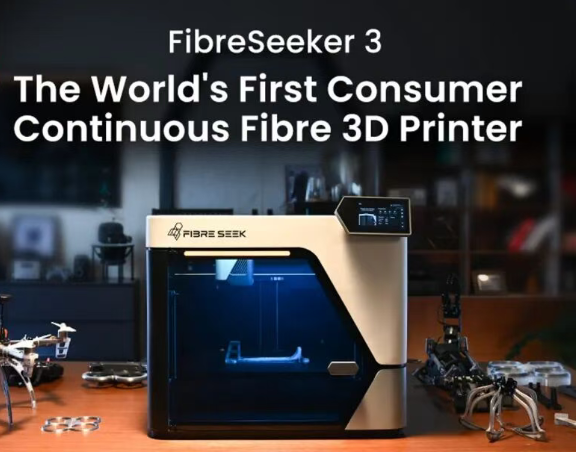
Within the 3D printing industry, the consumer market has long been dominated by “plastic prototypes,” while high-strength, industrial-grade equipment remained the exclusive domain of a select few enterprises due to prohibitive cost barriers. The advent of the FibreSeeker 3 seeks to bridge this divide—a feat bolstered by the dual advantages of China’s robust supply chain capabilities and precise market positioning. Furthermore, its emergence reflects a deeper, industry-wide trend: a fundamental shift in the global 3D printing sector from mere “proof-of-concept” demonstrations to the delivery of truly “functional applications.”
Technical Breakthrough: A Leap from “Brittle Plastic” to “Aerospace-Grade Strength”
Traditional FDM (Fused Deposition Modeling) 3D printers, relying solely on pure thermoplastic materials, have long suffered from a critical flaw: weak interlayer adhesion. Consequently, the resulting prints are prone to brittleness and cracking, possess poor load-bearing capacity, and are thus relegated to non-functional scenarios such as model display and concept validation. This inherent limitation has long confined consumer-grade 3D printing to the awkward status of a “niche novelty” or “toy,” rendering it difficult to penetrate the realm of genuine engineering applications.
The core competitive advantage of the FibreSeeker 3 lies in its proprietary continuous fiber co-extrusion technology—an industrial-grade process previously reserved for the aerospace and high-end manufacturing sectors, which this Chinese startup has successfully “desktop-ized.” The device features an independent dual-extruder architecture: a primary nozzle handles standard base materials such as PLA, ABS, PC, and PA, while a secondary nozzle is dedicated to feeding continuous carbon fibers. Through a high-precision temperature control system and synchronized pressure technology, bundles of carbon fibers are seamlessly embedded within the molten plastic matrix, thereby creating a “fiber-reinforced composite material.” Data indicates that the printed output from this device achieves a tensile strength of up to 900 MPa—ten times that of standard 3D printing materials. This level of strength approaches that of aerospace-grade aluminum alloys, yet weighs only half as much. Even more practically, users can seamlessly switch between three distinct operating modes to suit their specific needs: a high-speed mode (500 mm/s) ideal for rapidly prototyping plastic models; a high-strength mode that enables the synergistic deposition of fibers along a part’s specific stress paths; and an ultra-strength mode that supports full-fiber output, directly addressing the manufacturing requirements for load-bearing components such as drone frames, robotic joints, and industrial fixtures. This signifies that, for the first time, consumer-level users can—at an affordable price point—print functional parts that are ready for immediate, practical application.
Hardware-Software Synergy: Lowering the “Barrier to Entry” for Industrial Processes
The technical challenges inherent in continuous fiber printing have never been limited solely to the hardware itself; rather, they lie critically in the precision of fiber tension control and path planning. Should tension become unbalanced, the fiber is prone to snapping or deviating—issues that directly result in print failure. The solution implemented in the FibreSeeker 3 is a deep, synergistic integration of hardware and software.
On the hardware front, the device features built-in fiber tension sensors and a real-time filament breakage detection module. Coupled with an adaptive vibration compensation algorithm, these components allow the system to dynamically adjust fiber feeding speed and tension in real time, ensuring that the carbon fiber is deposited without snapping or deviating from its intended path. Furthermore, the device’s generous build volume of 300 × 300 × 245 mm—combined with all-metal linear guide rails—provides robust assurance of dimensional consistency during long-duration print jobs, effectively preventing device vibrations from compromising the precision of the final product.
Regarding software, FibreSeek’s proprietary slicing software, Aura, has completely reimagined the operational logic behind continuous fiber printing. Unlike traditional slicing software, Aura incorporates a built-in topology optimization algorithm that automatically identifies areas of high stress concentration within a 3D model, subsequently generating the necessary anchoring points and infill paths for the continuous fibers. Consequently, users require no specialized engineering expertise; by simply setting a target strength threshold, the software automatically generates the optimal G-code (printing instructions).
Additionally, the device’s 5-inch touchscreen interface and integrated high-definition AI camera further lower the operational barrier. The camera provides real-time monitoring of the printing process; should any anomalies occur—such as a snapped fiber or a clogged nozzle—the system immediately triggers an alert and supports “resume-from-breakpoint” functionality, thereby enabling even non-professional users to effortlessly complete complex, engineering-grade printing tasks. Market Strategy: Steering Clear of the “Red Ocean” to Secure a Niche in High-Value Growth Markets
With a crowdfunding starting price of $2,699—including a “Super Early Bird” tier at $2,399—the launch might appear to be a price war; in reality, however, it represents FibreSeeker’s meticulously crafted strategy to break through market stagnation via differentiation. While industry giants like Bambu Lab and Creality focus on mainstream segments such as “multi-color printing” and “ultra-high-speed printing”—becoming entangled in a spiral of product homogenization—this startup has chosen a more precise path. It targets the core, non-negotiable needs of engineers, R&D teams, and “hardcore” makers: the ability to directly produce load-bearing, testable end-use parts at a low cost.
Underpinning this strategy is the robust support of China’s mature supply chains and large-scale manufacturing capabilities. By leveraging supply chain clusters in hubs such as Shenzhen and Suzhou, FibreSeeker has slashed the device’s BOM (Bill of Materials) costs by nearly 90%. This achievement enabled the breakthrough of delivering “industrial-grade performance at a consumer-level price,” thereby paving the critical path for the downward migration of industrial technology into the consumer desktop market.
Industry data indicates that in 2024, global shipments of consumer-grade 3D printers are expected to surpass 2 million units—a year-over-year increase of 20%—while the market for industrial-grade equipment shows signs of contraction. FibreSeeker keenly identified this trend; rather than blindly following the giants into homogenized competition, the company carved out a high-value growth market through a strategy of “performance-driven premium + reasonable pricing.” For R&D teams, this device significantly reduces the costs associated with prototype validation and small-batch production; for hardcore makers, it unlocks new possibilities for fabricating high-strength, lightweight parts on their own.
A Decade of Accumulation: The Inevitable Result of Localization and Capital Support
The explosive success of the FibreSeeker 3 is not a serendipitous foray into a new field, but rather the inevitable outcome of a decade of technological accumulation and strategic localization. Its core technology is rooted in the patented Continuous Fiber Co-extrusion (CFC) process, pioneered by Anisoprint in 2014. Over the past ten years, this technology has served leading global enterprises—including NASA, Airbus, BMW, and Apple—accumulating a wealth of mature experience in industrial applications. In 2023, Anaiso 3D (FibreSeek’s parent company) completed the comprehensive localization of its technology, patents, and core expertise in Suzhou. This move was swiftly followed by a 30 million RMB angel round investment from Sequoia Capital, as well as a Series A round of nearly 100 million RMB led by GF Xinde. The company’s founder, Liu Rui—a post-95s entrepreneur who is currently still pursuing a Ph.D. in Intelligent Manufacturing at the Hong Kong University of Science and Technology (HKUST)—assembled a core team with backgrounds from institutions such as the University of Science and Technology of China (USTC) and MIT. Together, they decisively executed a strategic pivot “from B2B to B2C,” shifting away from their long-standing reliance on industrial clients to focus instead on the incremental demand within the consumer market.
“Industry was our original calling, but the consumer market is our inevitable destiny.” This statement by FibreSeek’s former CTO encapsulates the core logic behind the company’s transformation. With the addition of former executives from global 3D printing giants—such as Desktop Metal and Markforged—FibreSeek has further solidified its global distribution channels, laying a robust foundation for its products to reach the international market.
Conclusion: Reshaping the Boundaries of Consumer-Grade 3D Printing
The advent of the FibreSeeker 3 represents more than just an innovation in desktop 3D printing hardware; it marks a true milestone for the global consumer-grade 3D printing industry. By—for the first time—introducing industrial-grade continuous fiber technology into the consumer market, it fundamentally shatters the entrenched perception that “consumer-grade” is synonymous with “prototyping.” Instead, it propels the industry forward, shifting the focus from mere “proof of concept” to actual “functional delivery.”
For professional users seeking high-strength, lightweight components, the FibreSeeker 3 offers what is currently the most engineering-value-driven solution available in the consumer market. For the 3D printing industry as a whole, the success of this Chinese startup demonstrates that the combined power of “technological downscaling” and “supply chain advantages” is sufficient to carve out a new niche within a “red ocean” market currently dominated by industry giants.
As FibreSeek continues to iterate upon its materials ecosystem and its “Aura” slicing software, continuous fiber printing is poised to experience a desktop-level boom between 2026 and 2027. By then, consumer-grade 3D printing will no longer be merely a “niche hobby”; it will truly integrate into a wider array of scenarios—including R&D, manufacturing, and the maker community—becoming a vital tool for driving innovation. And in the midst of this industry-wide transformation, Chinese enterprises—leveraging their dual advantages in both technology and supply chains—are seizing the initiative to lead the way.