Introduction
Currently, approximately 27% of people worldwide suffer from sleep disorders, with adults averaging only 6.85 hours of sleep per night , far below the healthy sleep data published by the World Health Organization . Meanwhile , smart mattresses, once jokingly referred to as “electrically rocking beds,” are undergoing a transformation thanks to AI big data models and high-precision sensors.
From Eight Sleep , used by Elon Musk and Mark Zuckerberg, to annual sales of $500 million and a valuation of $1.5 billion, to Chinese brands like Siri exceeding $1 billion in valuation within months, smart mattresses have moved from being a “geek’s novelty” to becoming a mainstream consumer product by early 2025 or 2026. So, how can we, as consumers , see through the marketing hype and make rational decisions?
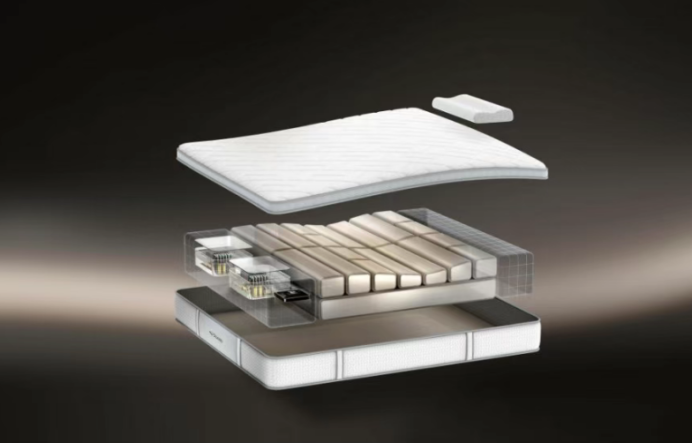
I. Technological Leap: What is a True “AI Smart Mattress”?
Over the past decade, smart beds have mostly relied on mechanical adjustments such as “one-button height adjustment and zero-gravity mode,” which have been criticized by users as “pseudo-smart” and even ridiculed as nursing beds only for the elderly. Today, the core of the new generation of AI mattresses lies in their seamless self-adaptation and active intervention .
- Sensing layer : Built-in high-density pressure matrix sensor to capture weight distribution, sleeping posture changes and micro-breathing movements in real time.
- Decision-making level : Relying on local AI chips or cloud-based large models (such as combining DeepSeek and other algorithms), human body data is compared with millions of sleep samples to dynamically adjust the firmness of the zoning or the angle of the bed frame.
- Execution layer : High-quality products operate with noise levels controlled at 20-25 decibels (close to a library environment), and the adjustment process is smooth and without any jerks, achieving full-cycle intervention of “relaxation before sleep, stress relief/anti-snoring during sleep, and natural awakening after sleep”.
The primary principle for purchasing intelligence is whether it can intervene without the user’s awareness; this is the only standard for testing true intelligence.
II. Industry Trends 2025-2026Q1: Ecological and Medical Applications
Based on recent market trends, the AI mattress industry is currently experiencing two major turning points:
- From individual products to a 24-hour sleep ecosystem : Brands are no longer selling mattresses in isolation, but are instead integrating hardware such as smart rings, temperature-controlled mattress protectors, and sleep-aid ambient lights. Daytime activity/heart rate data is integrated with nighttime mattress algorithms to form a closed loop of “monitoring-intervention-feedback”.
- From experience optimization to clinical validation : In 2025, several leading companies collaborated with brain-computer interface companies and top-tier hospitals to conduct research on sleep disorder intervention. In the first quarter of 2026, models with Class II medical device registration certificates or clear clinical data support became the entry threshold for the high-end market. The industry is accelerating its efforts to bridge the gap between “psychological comfort” and “medical assistance.”
III. Consumer Buying Guide: 4 Steps to Make a Rational Decision
- Focus on the algorithm, not just the parameters : the core is the AI’s “continuous learning ability.” Confirm whether the system supports OTA upgrades and whether it adapts to personal habits over time. Avoid products that rely solely on preset gear switching.
- Focus on the experience, not gimmicks : A minimum of 5 minutes of in-person testing is required. Reputable brands offer rapid matching systems (such as a 5-minute body shape/stress scan) that accurately recommend firmness/softness. Be wary of marketing claims lacking scientific basis, such as “quantum sleep aid” or “direct brainwave connection.”
- Check core components and after-sales service : Motors, control boards, and sensors are critical to lifespan. A warranty of ≥3 years for the entire machine and ≥5 years for core motors/sensors is recommended. Confirm whether the manufacturer promises software maintenance for more than 3 years to avoid the machine becoming an “electronic brick.”
- Match budgets as needed :
- 10,000-20,000 yuan : Basic sensing + zoned temperature control + manual/APP adjustment, suitable for those who have difficulty falling asleep.
- Priced between 20,000 and 40,000 yuan : AI adaptive adjustment + anti-snoring linkage + ecological hardware access, suitable for people with long-term neck and shoulder strain and snoring.
- Priced at 40,000 RMB or more : Medical-grade data monitoring + clinical algorithm certification + whole-house smart hub, suitable for high-net-worth individuals and those with severe sleep disorders.
Conclusion
Smart mattresses are not simply sleep aids; they are essentially “digital stewards” that comprehensively protect sleep health. Entering 2026 , the industry’s development trend is clearly returning to its “human-centered” essence, abandoning flashy gimmicks and focusing on truly improving users’ sleep quality and overall well-being.
Therefore, it is recommended that consumers prioritize brands with core self-developed algorithm capabilities, well-developed offline experience scenarios, and transparent and reliable after-sales service processes when making their choices.
After all, the highest level of intelligent technology is always subtle and pervasive – you can hardly feel its presence, yet it silently creates the most suitable sleep environment, ultimately leaving you with a deep, peaceful, and restful night’s sleep.
Leave a Reply