
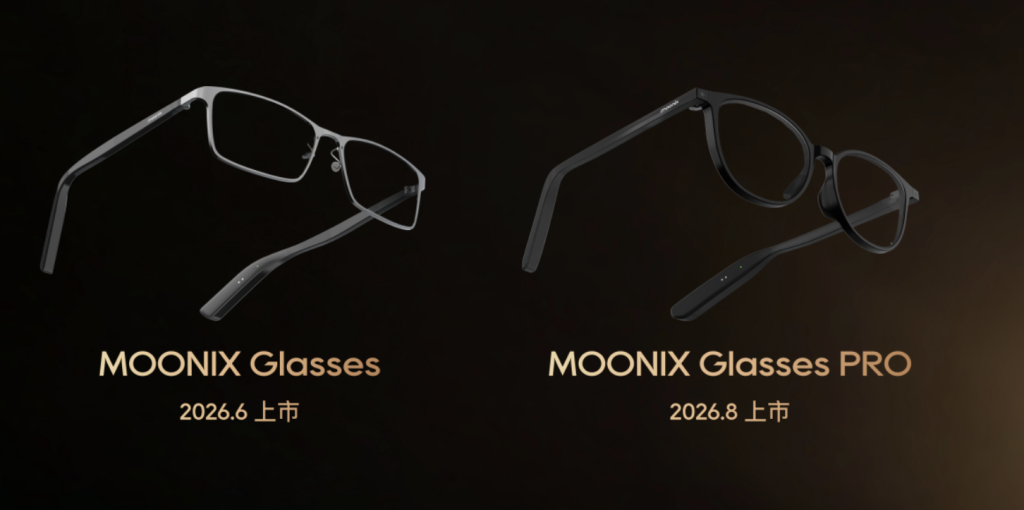
On April 29, 2026, Xinmou Technology (Hangzhou) Co., Ltd. held its global brand and product launch event at the San Francisco Palace of Fine Arts in Silicon Valley, officially unveiling its first flagship product line—Moonix AI Glasses (Chinese name: “Monet AI Glasses”). The two models, standard version focusing on audio recording and Pro version featuring video recording, both emphasize ultra-lightweight industrial design and proactive seamless AI interaction. The standard version is expected to launch in June, with the Pro version following in August, simultaneously worldwide.
Industry Dilemma: Why AI Glasses Remain Niche
AI glasses are currently viewed as the most promising next-generation personal computing platform to potentially replace smartphones, as they sit closest to the human face’s core triangular zone, covering both visual and auditory senses. However, the industry has fallen into a “addition logic” trap: competing over computing power, stacking sensors, pursuing exaggerated forms, and emphasizing visual interactions. This has directly resulted in products weighing consistently over 40 grams, with some display-enabled AI glasses exceeding 60 grams.
“Consumers must sacrifice their most basic wearing experience to accommodate various smart features,” said Guo Yuchen, founder of Xinmou Technology, at the launch event. He bluntly stated that this dilemma is hindering AI glasses from achieving true mass adoption.
Breakthrough Solution: Technology Through Subtraction
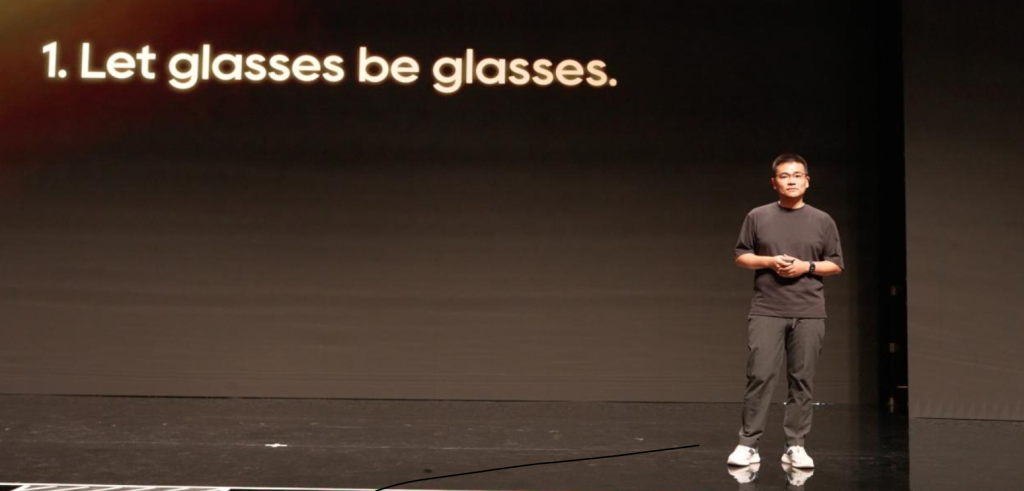
Xinmou Technology chose a distinctly different path. At the launch event, Guo Yuchen proposed the core product philosophy: “Respecting tradition, returning to essence, and technology through subtraction.” In his view, the first principle of glasses is “lightweight, seamless, and design-first,” meaning AI glasses should first be excellent glasses, then a smart device.
Based on this philosophy, Moonix AI Glasses achieved multiple breakthroughs:
Ultra-Lightweight: The standard version weighs just 14.9g, while the Pro version is only 17.9g, with temple arms as thin as 4mm. What does this mean? The lightest AI glasses on the market currently weigh around 28g, mainstream products generally exceed 40g, and the Meta Ray-Ban Display reaches 69g. Moonix’s 14.9g not only sets a new industry record but is even lighter than many regular acetate glasses.
Modular Design: Moonix integrates all electronic components inside the temple arms, completely decoupling frames from temples. This design not only provides more flexible space for internal stacking but also allows users to freely replace front frames. Over 100 frame options will be available at launch, covering business formal, daily commute, casual social, and reading styles, with support for prescription and sunglass lenses.
Proactive AI: Transitioning from Tool to Companion
Weight and appearance address “whether users are willing to wear them,” while “proactive AI” targets “what happens every day after wearing them.”
Traditional AI glasses operate in “passive AI response” mode: after users give commands, the device takes photos, records audio, then calls upon large models for recognition, translation, and Q&A. Moonix’s breakthrough lies in its “proactive AI assistance”—the device autonomously transforms personal data into valuable scene experiences.
The standard version features 6 micro-microphones for all-day audio capture; the Pro version adds a 1080p full HD camera supporting Always-On all-day recording and high-frequency capture. Based on RAG technology, the system automatically segments recorded meetings, interviews, inspirations, and daily conversations into event nodes, building an easily retrievable structured timeline and private knowledge base.
The accompanying Moonix App uses a timeline as its core architecture, aggregating user data across learning, work, travel, and life dimensions. In workplace scenarios, the system automatically aggregates meeting audio, text notes, and key moments, intelligently extracting key points and generating standard meeting minutes with editable PPTs in one click. For personal recording scenarios, it filters video clips from the timeline to quickly create personal Vlogs.
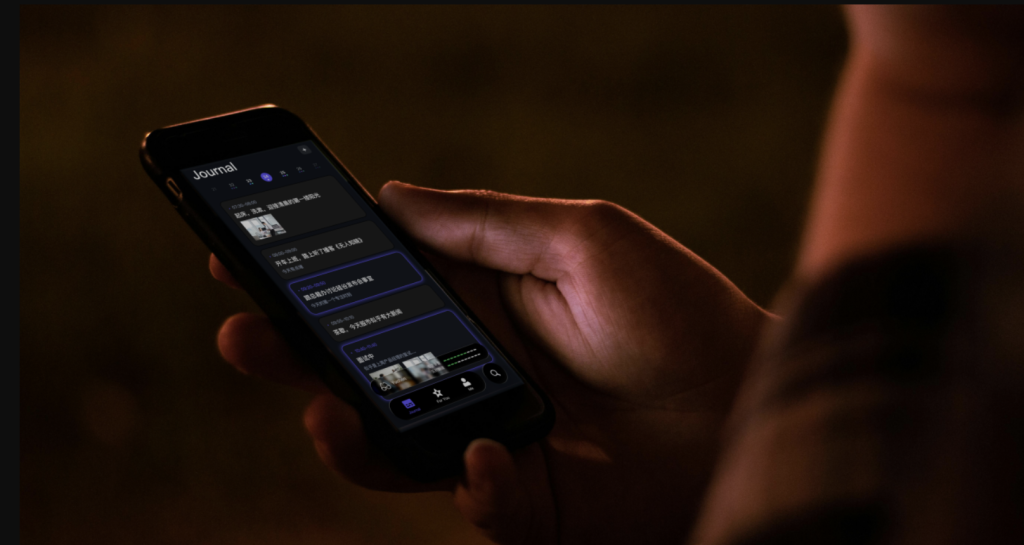
“This AI glasses won’t stop at the features launched today. Based on App-side workflows, it can expand infinitely,” Guo Yuchen stated. He noted that as usage time extends, the AI learns user expression habits, focus areas, and decision-making styles, providing responses that increasingly align with user thinking.
Regarding battery life, Moonix employs innovative power balance algorithms, enabling both standard and Pro versions to achieve up to 16 hours of comprehensive battery life, meeting all-day usage needs.
Privacy Commitment: End-to-End Encryption and Open Source
With zero data popups, no bright light flashes, and no mechanical interaction interference, Moonix commits to achieving “intelligent presence without stealing the show” in an ultra-seamless experience.
On privacy protection, Moonix AI Glasses implement end-to-end encryption ensuring data security throughout collection, transmission, and processing. The team solemnly commits to gradually open-sourcing key privacy and security-related module codes, accepting public supervision from the global developer community.
“With extreme openness and transparency, we build a trustworthy AI hardware security foundation,” Guo Yuchen emphasized at the launch event.
Launch Information and Market Strategy
Moonix AI Glasses standard and Pro versions will launch in June and August respectively this year, simultaneously in domestic and international markets, with official pricing and sales channels to be announced.
Partner recruitment has begun in Beijing, Shanghai, Guangzhou, Shenzhen, Suzhou, Hangzhou, and other cities, with users able to book offline experience sessions.
From an industry perspective, Moonix’s launch marks a crucial step for AI glasses transitioning from “geek toys” to “mass daily consumer products.” With on-device models, AI agents, and multimodal sensing gradually maturing, redefining product value through ultra-lightweight design and proactive AI may lead the industry out of the “weight internal competition” dilemma.