Zhipu AI recently launched an interesting product—the Lingji AI Learning Card. At 799 yuan, featuring an e-ink screen, powered by the GLM large model, and designed specifically for primary and secondary school students’ Q&A needs. Not a tablet, not a learning machine, but a card-sized device that fits in your pocket.
This positioning is precise. The current education hardware market is divided between thousand-yuan AI learning machines (iFLYTEK, TAL) and hundred-yuan dictionary pens (NetEase Youdao, Alpha Egg), with a gap for “lightweight AI Q&A” in between. The Lingji Learning Card aims to fill this exact.
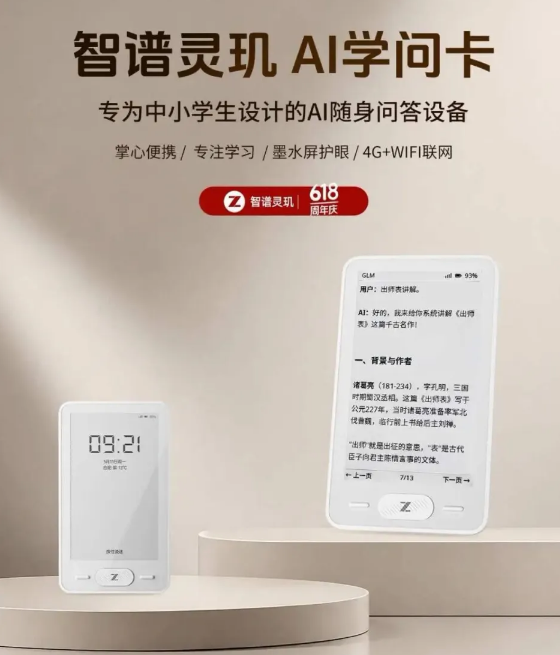
Product Overview: A Card, An AI Tutor
Who is Zhipu AI? A first-tier domestic large model player, with the GLM series earning solid reputation for Chinese understanding and generation. Previously focused on B2B APIs and C-end chatbots (Zhipu Qingyan), this move into education hardware signals their intent to bring GLM capabilities from “cloud” to “edge.”
The Lingji Learning Card’s core design philosophy: lightweight, focused, and eye-friendly.
Lightweight: Card-sized, estimated under 100g—lighter than phones, larger than dictionary pens. The e-ink screen’s extremely low power consumption means one charge lasts a week.
Focused: Does one thing only—AI Q&A. Not an all-in-one learning machine; no videos, games, or social media. Students with questions about problems, vocabulary, or knowledge points can snap a photo or use voice input, and the GLM large model provides explanations and guidance.
Eye-Friendly: E-ink screens don’t emit light themselves, relying on ambient light reflection, causing far less eye strain than LCD/OLED displays. This is one of the most important selling points for parents.
Specifications: How Much Educational Intelligence Fits in One Card
| Spec | Details |
|---|---|
| Screen | Electronic Ink Display (E-Ink) |
| Size | Card-sized (estimated credit card dimensions) |
| AI Model | Zhipu GLM Large Model (edge + cloud hybrid) |
| Functions | AI Q&A, knowledge point analysis, learning records |
| Input Methods | Voice + photo (likely with camera) |
| Battery | E-ink low power consumption, estimated 7-14 days |
| Connectivity | Wi-Fi/Bluetooth |
| Target Users | Primary and secondary students (ages 6-18) |
| Price | 799 yuan |
| Pilot Status | Piloted in multiple schools nationwide |
Data source: Zhipu AI official launch materials
Hands-On Experience: Can It Replace a Tutor?
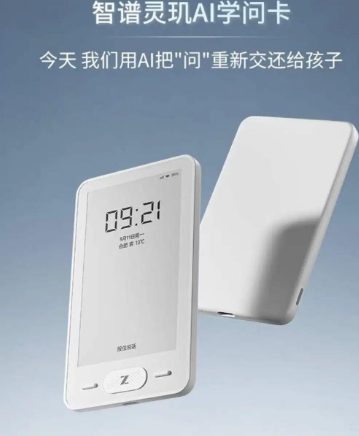
Bottom line first: The Lingji Learning Card can replace “simple Q&A” tutoring scenarios, but cannot replace “systematic tutoring” or “habit cultivation.”
AI Q&A Quality: The GLM large model has advantages in Chinese understanding, capable of explaining math problem steps, analyzing Chinese reading comprehension, and explaining English grammar in “human language.” But the common large model weakness—hallucinations (confidently saying nonsense)—is fatal in education scenarios. If Lingji provides a student with a solution containing a formula error, the student might carry that mistake through the entire semester.
Zhipu’s solution may be an “edge + cloud hybrid” approach: simple questions handled by a local GLM small model, complex questions uploaded to the cloud large model. But regardless, education scenarios demand far higher accuracy than chat scenarios, requiring Zhipu to invest heavily in model training and answer verification.
Learning Management Features: The Lingji Learning Card likely includes learning records and weak point analysis. After each Q&A session, the AI records the student’s questions, error types, and knowledge mastery status, generating personalized learning reports. If executed well, this feature holds high value for parents—finally eliminating the need to ask “what did you learn today” every evening.
E-Ink Experience: E-ink’s refresh rate is too low for dynamic content (videos, animations), but static text display is extremely comfortable. For “reading explanations and solutions” learning scenarios, e-ink is a bonus. However, photo input recognition speed and voice input response latency require real-world testing.
School Pilot Value: Zhipu’s choice to pilot in schools rather than direct-to-consumer sales is smart. In school environments, teachers can supervise usage, provide product feedback, and validate teaching effectiveness. Promoting to parents after successful pilots carries more credibility than direct advertising.
Comparison: Lingji vs iFLYTEK AI Learning Machine vs Youdao Dictionary Pen
| Feature | Zhipu Lingji Card | iFLYTEK AI Learning Machine | Youdao Dictionary Pen X6 Pro |
|---|---|---|---|
| Price | 799 yuan | 3,000-8,000 yuan | 1,000-1,500 yuan |
| Form Factor | E-ink card | Tablet/laptop | Pen-shaped scanner |
| AI Model | GLM (self-developed) | iFLYTEK Spark (self-developed) | Youdao Ziyue (self-developed) |
| Function Scope | AI Q&A focused | Full-subject tutoring + videos + exercises | Scan translation + listening |
| Eye Protection | E-ink (excellent) | LCD screen (average) | Small LCD screen (average) |
| Portability | Extremely high (card-level) | Low (tablet-level) | High (pen-shaped) |
| Content Ecosystem | AI-generated dependent | Built-in massive courses | Built-in dictionary database |
| Parental Controls | Naturally restricted (no entertainment) | Requires parental mode setup | Naturally restricted |
| Applicable Scenarios | Fragmented Q&A | Systematic learning | Vocabulary lookup |
The three products occupy completely different tracks. The iFLYTEK learning machine is a “home classroom,” the Youdao dictionary pen is a “portable dictionary,” and the Lingji Learning Card is a “pocket tutor.” For parents with ample budgets and children needing systematic tutoring, choose iFLYTEK; for children weak in English requiring extensive vocabulary lookup, choose Youdao; for those needing only a lightweight AI Q&A tool with limited budget, Lingji is a solid choice.
Pros and Cons
| Pros | Cons |
|---|---|
| 799 yuan budget-friendly, low trial cost | Single-function, only AI Q&A, no videos/exercises |
| E-ink eye protection, parent reassurance | Large model hallucination risk, fatal in education |
| Card form factor, always available | Photo/voice input experience to be verified |
| Naturally anti-addiction (no entertainment features) | Dependent on school pilot promotion, low C-end awareness |
| GLM Chinese understanding advantage | Overlaps with Zhipu Qingyan app functions, hardware necessity questionable |
| School pilot endorsement, teaching scenario validation | Battery life and durability require long-term testing |
Who Should Buy
Recommended for:
- Parents of primary and secondary students with limited budgets needing AI Q&A tools
- Families with extremely high eye protection requirements rejecting LCD screens
- Children already owning tablets/computers needing supplementary lightweight AI learning tools
- Families in schools with pilot programs and teacher recommendations
Not recommended for:
- Families needing systematic full-subject tutoring and video courses (choose learning machines)
- Those whose primary need is English vocabulary lookup and translation (choose dictionary pens)
- Risk-averse parents demanding extremely high large model accuracy with zero tolerance for errors
- Families already satisfied with the Zhipu Qingyan app (function overlap)
FAQ
Q: Does the Lingji Learning Card require internet connectivity?
A: Simple Q&A may support local edge processing, while complex questions require internet access to the cloud GLM large model. Recommend using in home or school Wi-Fi environments.
Q: Can the e-ink screen display math problem images and formulas?
A: E-ink can display static images and text, but with limited grayscale levels; complex geometric graphics may display less effectively than color screens. Formula display is usually fine.
Q: When will school pilot programs open to parent sales?
A: Official C-end sales timeline has not been announced. Recommend following Zhipu AI official channels or school notifications.
Q: Does the 799 yuan include subsequent service fees?
A: Currently unclear whether subscription or value-added services apply. Recommend confirming whether permanent AI Q&A service is included, or if subsequent paid upgrades are required before purchase.
Conclusion
The Zhipu Lingji AI Learning Card is a “precisely positioned” education hardware product. It doesn’t pursue all-in-one capabilities but instead maximizes one thing—AI Q&A—with lightweight design, eye protection, and affordability. At 799 yuan, its pricing sits at the “floor” of AI education hardware, lowering the barrier for parents to try it out.
But Lingji’s success depends on three critical questions: First, can the GLM large model’s accuracy in education scenarios reach parent-trustworthy levels? Second, can school pilots quickly convert to C-end word-of-mouth? Third, can Zhipu continuously iterate the product rather than following the pattern of many AI hardware products that “peak at launch”?
If Zhipu can resolve these three questions well, the Lingji Learning Card may become a “blockbuster” in AI education hardware—not because it has the strongest features, but because it has the most precise positioning. In an era where AI learning machines cost thousands of yuan, a 799-yuan pocket AI tutor is indeed a heartwarming choice.