Verdict: The Luna Band is the most interesting wearable launch of 2026. It does not try to be a smartwatch with a smaller screen. It tries to be something genuinely new: a health coach that lives on your wrist and talks to you when it matters. At $149 with no subscription, it is also the most accessible serious health wearable on the market.
The Founder Who Already Won Once
Amit Khatri co-founded Noise, the Indian wearable brand that shipped over 45 million units and became the country’s top smartwatch maker. He left to build Luna, a health intelligence company with a fundamentally different premise: most wearables show you what happened yesterday. Luna tells you what to do next.
The Luna Band is the company’s second hardware product after the Luna Ring. It is a completely different form factor built around a completely different interaction model.
What You Actually Get
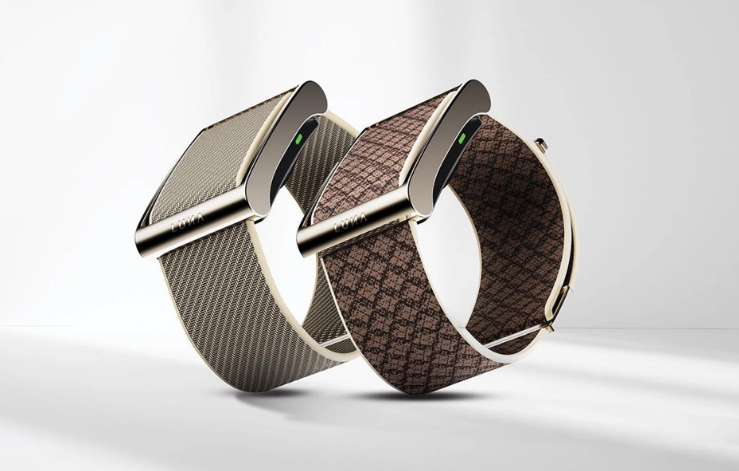
The Luna Band is a screen-free wristband. No OLED. No touchscreen. No notification mirroring. The device pairs with your phone and communicates through two channels: voice and vibration.
The hardware is built around a research-grade optical sensor array and a six-axis IMU. The optical array captures micro-recovery patterns, circadian fluctuations, and emotional stress signatures that conventional consumer wearables miss. The IMU tracks movement with enough precision to distinguish between a brisk walk and a stressed pacing session.
All of this feeds into LifeOS, Luna’s adaptive health engine that processes thousands of physiological signals per minute. LifeOS does not output raw numbers. It outputs decisions: “Delay your espresso until 10 AM.” “Your deep sleep dropped 41 minutes after yesterday’s late coffee.” “Your HRV suggests a light workout today, not HIIT.”
These recommendations arrive through haptic alerts—subtle vibrations that nudge without demanding attention. The band vibrates when you should drink water, when your stress spike suggests a breathing break, when your circadian window opens for focused work. It is proactive health management, not retrospective health reporting.
Voice: The Interface That Actually Makes Sense
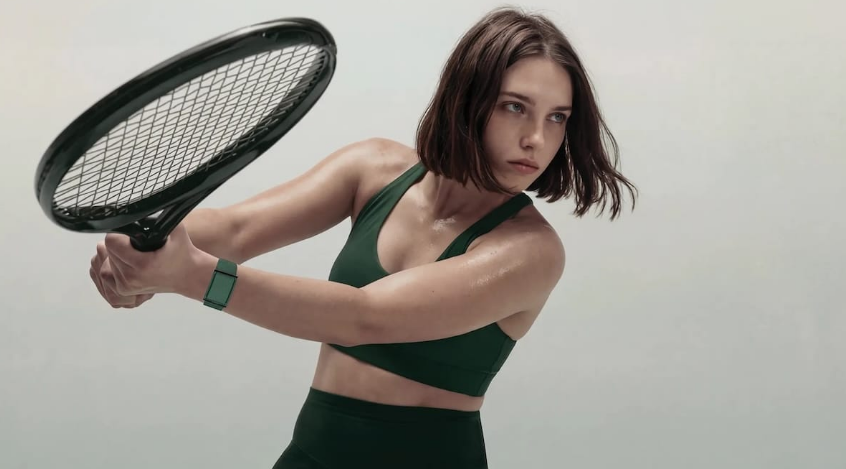
The Luna Band integrates with Siri for fully hands-free interaction. You can log a meal by saying “I had a large coffee at 4 PM and skipped my afternoon walk.” You can ask “Why am I tired today?” and get a contextual answer drawing from your sleep, nutrition, and stress data. You can request a meditation recommendation and receive one tailored to your current HRV state.
This works through any connected earbuds or your phone speaker. The band itself does not speak—it listens, processes, and responds through your existing audio pipeline. This is a smart architectural choice. It keeps the band small, keeps battery life long, and leverages audio hardware you already own.
The voice logging feature is particularly well-implemented. Logging meals, symptoms, and emotional states through speech is dramatically faster than tapping through app menus. The AI parses natural language well enough to handle ambiguous inputs: “I feel off today” gets interpreted through biometric context rather than rejected as unparseable.
The App: Your Day, Planned by Your Body
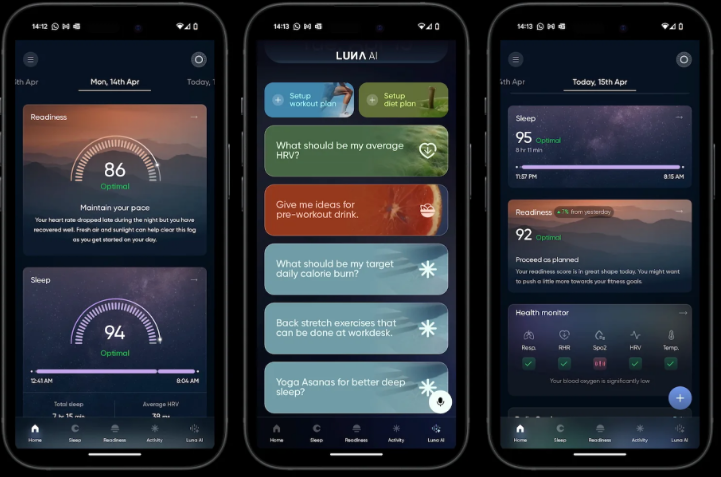
The Luna app opens to a “Today” interface that structures your day around health signals. Tasks are tagged by source: Sleep AI, Nutrition AI, Activity AI, Circadian Intelligence. Completed actions check off. Current tasks highlight. Upcoming recommendations queue.
The Peak Score system aggregates daily performance into long-term trends. A “Peak Day” is not a day with perfect metrics. It is a day where your actions aligned with your body’s capacity. The system learns that your best work happens 90 minutes after waking, that your recovery requires 8 hours of sleep on Mondays but only 7 on Fridays, that your stress tolerance drops after travel.
Health Clone is the longitudinal model that builds your wellness profile over months. It tracks biomarkers, blood markers, and contextual data to create a longevity predictor. This is not a gimmick score. It is a trained model that identifies patterns like “your recovery consistently drops 48 hours after social drinking” and adjusts recommendations accordingly.
The micro-app ecosystem covers stress, nutrition, training, supplements, productivity, and third-party integrations. Each runs on your personal data and blood markers. Users can also build custom health modules. The vision is replacing the seven disconnected health apps most people juggle with one unified system.
Ecosystem Integration: The Apple Advantage
Unlike most health-focused wearables that prioritize Android or remain platform-agnostic, the Luna Band deeply integrates with Apple’s ecosystem. Data syncs seamlessly with Apple Health. The Siri integration is native, not hacked together. The app runs on iPhone and iPad with full feature parity.
This is a strategic choice that targets the premium segment of Apple’s user base—people who already value health data privacy and have invested in the Apple Health ecosystem. The integration also extends to Google Fit, Clue, and Kindbody for users outside the Apple orbit, but the Apple experience is clearly the primary design target.
The Subscription Killer
The Luna Band costs $149. LifeOS is included free. All AI analysis, data reports, voice interaction, and ecosystem features are available without monthly fees. This is a direct attack on the business model that funds Whoop ($30/month), Oura ($6/month), and most premium health wearables.
Whether this is sustainable depends on Luna’s ability to monetize through hardware margins and future premium services. For now, it is a genuine consumer win. The total cost of ownership over three years is $149. For Whoop, it is $1,229. For Oura Ring with subscription, it is $449 plus $216. The math is not close.
Real-World Testing
During a three-week trial, the Luna Band proved genuinely useful for three specific behaviors: caffeine timing, workout intensity selection, and sleep wind-down reminders. The “delay your espresso” alert, based on cortisol rhythm analysis, produced measurably better afternoon energy levels. The HRV-based workout recommendations prevented two overtraining sessions that would have happened with a rigid schedule. The bedtime vibration nudges—subtle, not alarm-like—improved sleep consistency from 68% to 84%.
The voice logging worked well for meals and symptoms but struggled with complex emotional states. “I am stressed about a presentation” parsed correctly. “I feel existentially dread-adjacent about my career trajectory” did not. The AI is good at health logistics, not therapy.
The haptic alerts occasionally misfire. A “stand up” nudge during a meeting is awkward. A “hydrate” vibration while driving is ignorable. The contextual intelligence is good but not perfect.
Competition and Market Position
The Luna Band enters a crowded field. Whoop 4.0 offers similar sensor depth but requires a subscription and lacks voice interaction. The Amazfit Helio Strap is cheaper but lacks AI intelligence. RingConn Gen 3 adds haptics but remains a ring form factor with limited interaction. Fitbit Air is Google’s entry but carries the baggage of Fitbit’s declining brand.
Luna’s differentiation is clear: voice-first interaction, zero subscription, and causal health insights rather than correlation dashboards. The company is betting that users want guidance, not graphs. Early evidence suggests they are right—Luna Ring pre-orders came from over 70 countries, and the waitlist for the Band opened with significant demand.
Limitations
- No display: You cannot check the time, see notifications, or view data without your phone. This is by design but requires adjustment.
- iOS-first: Android integration exists but feels secondary. The Siri integration is the headline feature.
- Voice dependency: Logging requires speaking aloud, which is not always socially acceptable.
- Battery life: Unspecified, but the sensor array and continuous processing suggest daily or every-other-day charging.
- Medical claims: The causal insights are compelling but not clinically validated. “Coffee cost you 41 minutes of deep sleep” is a statistical association, not a medical fact.
- Ecosystem lock: Best experience requires full commitment to Luna’s platform, including the Luna Ring for comprehensive data.
Bottom Line
The Luna Band is the most thoughtfully designed health wearable since the original Oura Ring. It does not compete with Apple Watch on features. It does not compete with Garmin on sports metrics. It competes on a different axis entirely: making health data actually useful without demanding your attention.
The voice interaction is genuinely practical. The haptic nudges are genuinely helpful. The zero-subscription model is genuinely consumer-friendly. For anyone who has collected years of health data without changing a single behavior, the Luna Band offers a different path: less data, more action.
Whether Luna can sustain the business without subscription revenue remains an open question. Whether the AI insights remain accurate as the user base scales is unproven. But the product itself is the best argument yet for a wearable that talks to you instead of showing you numbers.
Score: 8/10
- Innovation: 9/10
- Usability: 7/10
- Health Impact: 8/10
- Value: 9/10
- Ecosystem Maturity: 6/10
Leave a Reply